
How can a practice turn implant searches into consultation enquiries?
Dental SEO ideas work best when they help a prospective implant patient decide whether your practice is a sensible place to start a conversation. This guide is for dental practices that provide implant consultations and want to attract more suitable local enquiries through clear, trustworthy website content rather than broad treatment claims. The immediate goal is not a treatment decision online; it is a well-informed request for an appropriate consultation.
Implant enquiries often involve more consideration than an urgent dental appointment. Visitors may be comparing travel distance, appointment availability, payment expectations, the consultation process and whether their concern is one your practice discusses. Your website should reduce uncertainty in those areas while leaving diagnosis, suitability and treatment recommendations to the clinical consultation. People-first pages that fully serve the reader’s purpose are a sound basis for search visibility and patient trust.
1. Decide which implant enquiries the website should invite
Start by agreeing on the enquiry you want a page to generate. This may be a person replacing a missing tooth, someone seeking information after being told they may need a replacement, or an existing patient ready to discuss options. Avoid treating every implant-related search as identical. A clear audience decision shapes the page title, questions answered, call to action and internal links.
Before publishing, confirm that the practice offers the consultation being promoted, which locations can provide it, how an appointment is requested, and which payment or insurance information can be stated accurately. If availability differs by clinician or site, write the page around the consultation process rather than implying every option is always available. This protects prospective patients from a misleading journey and prevents staff from handling avoidable mismatches.
2. Build a service page around the consultation decision
Create dental implant service pages with one primary purpose: explain why and how a person can arrange a consultation. Lead with a plain-language description of the service your practice discusses, then explain what happens before, during and after an initial appointment in only the terms your clinical team approves. State that suitability is assessed individually instead of using broad promises.
A useful page brief includes the intended patient question, approved treatment wording, practice location, appointment request method, relevant payment information, clinician or practice background that can be verified, and a list of questions the page must answer. Add a clear next step near the top and again after the practical detail. The action can be a call, booking route or enquiry form, but it should not demand sensitive health details merely to request contact.
What should appear before the booking prompt?
Give visitors enough information to judge whether a conversation is worthwhile before asking them to submit an enquiry. Explain the concern the consultation is designed to discuss, where it takes place, the broad appointment process, how the practice handles questions about payment, and what information the team can clarify. Keep clinical claims conservative and have the practice approve all treatment language.
A practical page-order check
Read the page as a first-time visitor. Can you identify the service, the location, the next step and the limits of what can be decided online without scrolling through unrelated dentistry content? If not, move that practical information upward and remove copy that only repeats the phrase implant treatment.
3. Map implant consultation keywords to one useful page
Use implant consultation keywords as clues to the questions people bring to search, not as phrases to repeat in every heading. Group terms by intent. A person looking for an implant consultation near a town needs location and appointment information, while someone asking what an implant consultation involves needs an explanation page that links to the booking route. Give each group a primary destination.
Example: A practice serves one main area and offers implant consultations at its central clinic. Its main implant page answers the broad consultation question and links to a page explaining the local clinic, access and appointment process. It does not create separate near-identical pages for every nearby suburb. The team checks whether calls and forms from each page are relevant to implant consultations before deciding what content deserves expansion.
4. Make the first appointment feel understandable
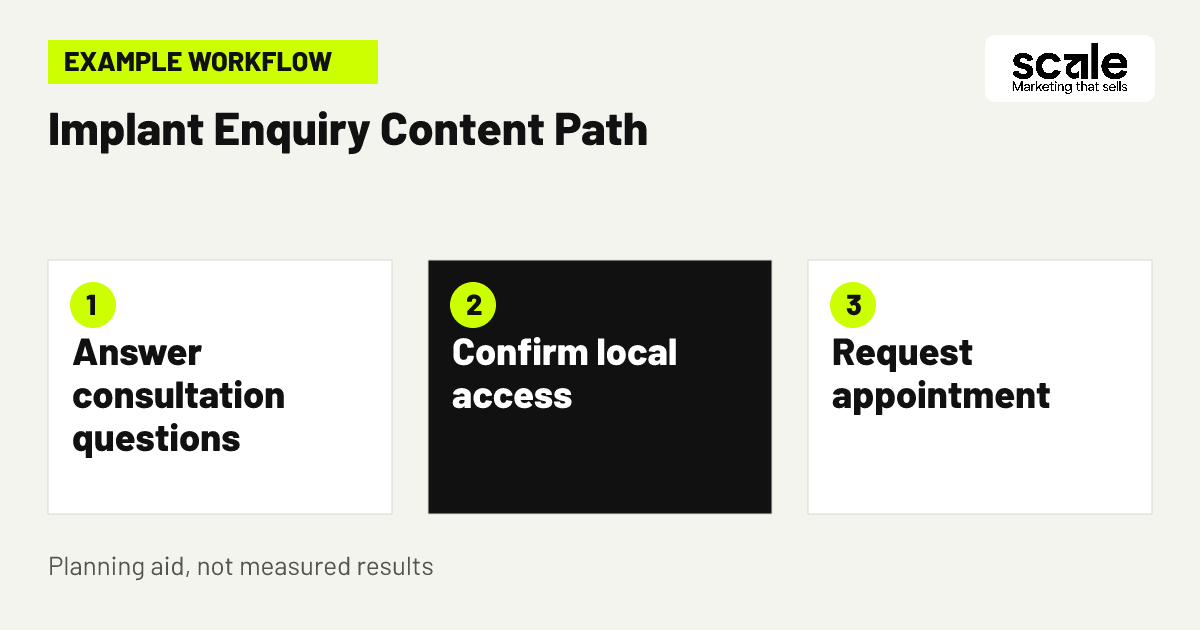
Uncertainty can stop a prospective patient from contacting a practice even when the service is relevant. Describe the consultation journey in a short sequence: how to request an appointment, what the team may ask at the outset, what topics can be discussed in person, and how the practice follows up. Do not turn this into a clinical prediction. Its job is to set practical expectations and make the next action feel manageable.
Include a contact option for visitors who have a simple scheduling question but do not wish to complete a long form. If your form is necessary, ask only for details required to respond to the marketing enquiry. Review the confirmation message too: it should explain when and how the practice will reply without suggesting that a submitted form confirms treatment or an appointment.
5. Strengthen local relevance with useful practice details
Local dentist SEO is more than placing a suburb name beside a service. On the main implant page, make the practice address, service area, contact route and appointment information easy to find. On the practice page, explain where visitors can find the clinic, how to contact the team, and any access details the practice has confirmed. These are decision details for someone weighing travel and convenience.
Keep names, addresses, phone details and operating information consistent wherever the practice publishes them. When details change, update the implant page, contact page and location content together. A visitor who sees conflicting information may abandon the enquiry, while staff lose time resolving questions that the website should have answered.
6. Create location pages only when they answer local questions
Dentist location pages are appropriate when a practice has distinct locations or can provide genuinely different local information. Each page should name the relevant clinic, describe how appointments are handled there, confirm which services can be discussed, and give accurate contact and access details. It should help a person decide where to enquire, not simply swap place names into a copied template.
Do not make pages for areas where there is no meaningful local connection or useful appointment guidance. Thin pages compete with one another and leave visitors without an answer to the real question: can this practice help me arrange the relevant consultation from where I am? Consolidate overlapping pages into the strongest useful destination when the information is substantially the same.
7. Use clinician and practice information to build confidence
An implant page should show who is behind the information without overstating qualifications or making unverified claims. Link to a practice or team page that presents approved clinician biographies, the practice’s approach to consultations and any credentials the practice has confirmed it may publish. Clear attribution helps readers understand the source of the content and supports a more trustworthy decision process.
Ask the clinical team to review pages for accuracy before publication and establish an owner for updates. This is especially important if clinicians, locations, appointment arrangements or treatment offerings change. A page is not finished once it is published; it needs a simple review process so prospective patients are not guided by outdated details.
8. Link supporting questions back to the consultation page
Supporting content can answer a narrow question that arises before an enquiry, such as what a consultation is for, what questions to bring, or how the practice discusses payment options. Each article should resolve one real concern and then point readers to the relevant implant consultation page when they are ready to contact the practice. It should not pretend to diagnose a condition or select treatment online.
Use descriptive internal links that tell visitors what they will find next, such as a link to the implant consultation process or the clinic contact details. Review the path on a phone as well as a desktop screen. If the booking route is hidden under navigation, buried after unrelated links or requires too many decisions, simplify it before adding more content.
9. Improve calls to action without using pressure
A suitable call to action identifies the next conversation, not an outcome. Use wording such as request an implant consultation, ask about appointment availability, or contact the practice to discuss the first visit, provided it accurately reflects the process. Pair the action with a brief reminder of what the person can expect next. This is clearer than vague buttons that only say submit or learn more.
Match the action to page intent. A visitor reading a broad implant service page may be ready to request a consultation, while a person viewing a location page may first need directions or a phone number. Preserve the main consultation route, but give people the practical information needed to use it confidently. Review form labels for clarity and remove fields that do not help staff respond.
10. Protect privacy in implant enquiry forms and tracking
Treatment interest can reveal sensitive health information. Review form fields, confirmation pages and analytics events with the people responsible for privacy and legal obligations before tracking them. Do not send free-text form answers, condition details, appointment notes or revealing page information to advertising platforms. A useful measurement plan can often rely on page paths and approved completion signals rather than patient detail.
Decide in advance which website actions are safe to measure, who can access reporting, and how the practice will connect marketing enquiries to booked consultations outside public-facing analytics. Keep any internal status labels practical and restricted, such as enquiry received, appointment requested, booked or not suitable. The point is better marketing decisions, not collecting unnecessary personal information.
11. Coordinate organic pages with approved search campaigns
If the practice uses Google Ads for implant-related searches, send ads to the most relevant approved implant consultation page rather than the home page. Keep the ad language, page content and booking action aligned so a visitor receives the information promised by the search message. Separate implant activity from urgent or general dentistry messaging because the patient’s decision and timing are different.
Review search campaign wording with the practice before launch, including availability, locations and payment statements. Organic SEO content can reveal the questions worth answering in ads, while paid search can show where the landing-page message needs clarification. Neither channel replaces the other: both need accurate service information and an enquiry route that respects patient privacy.
Marketing mistakes that weaken implant consultation pages
The most common mistake is writing a page that sounds comprehensive but never explains what a visitor should do next. Diagnose this by asking a staff member unfamiliar with the draft to find the service, location, contact method and consultation explanation. If they cannot do so quickly, rewrite the structure before adding more keywords. Repeated phrases are not a substitute for an answer.
Another frequent issue is treating every form completion as a successful lead. Review a small, privacy-appropriate sample of enquiry reasons with the reception team. Patterns such as requests for unavailable services, travel outside the practice area or confusion about payment information point to missing qualification content on the page. Update the wording and form options only after confirming what the practice can accurately state.
Avoid copied location pages and overly broad claims about suitability, outcomes or expertise. These pages can confuse visitors and create approval problems. Compare each page side by side: if the service explanation, local value and call to action are materially identical, merge or rewrite it. Keep only content that makes a distinct and useful contribution to a prospective patient’s decision.
Which measures show implant content is creating suitable enquiries?
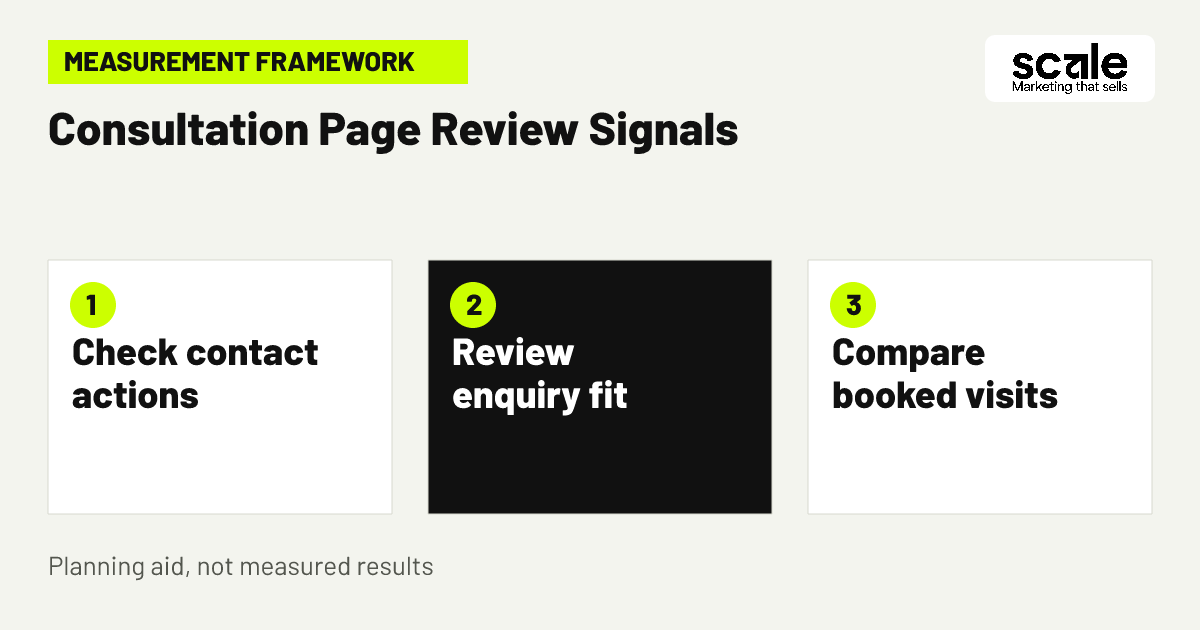
Measure the full path, not just page visits. Start with views of the implant service page and supporting content, then record approved actions such as a click to the contact route or a completed enquiry confirmation. Analytics events can measure user interactions such as page loads and link clicks, but implementation should be tested in available reporting tools and reviewed for privacy before it is relied upon.
Then use a protected internal process to classify whether the enquiry became a requested consultation, a booked visit, an attended visit or an unsuitable contact. Compare these stages by entry page and broad traffic source rather than exposing treatment details in analytics. A page with fewer raw enquiries may still be more valuable if reception identifies that its visitors understand the appointment purpose and service area.
When page views increase without enquiry actions, inspect whether the page answers the obvious questions, loads the contact route visibly and works well on a phone. When enquiries rise but bookings do not, review the accuracy of service, location and payment information with the team. When bookings occur but attendance is weak, examine confirmation and follow-up processes separately rather than assuming the SEO page is the cause.
Use a simple review rhythm
Review content, enquiry quality and booking feedback together at a regular interval chosen by the practice. Record one agreed change at a time, such as clarifying a location detail or moving the consultation explanation higher on the page. This makes it easier to understand why the enquiry mix changes and prevents constant unstructured edits.
Check tracking before interpreting it
Use available real-time or debugging views to confirm that an approved event fires only when the intended action occurs. Check it on the live booking path after changes to forms, buttons or consent settings. If the event is unreliable, fix the measurement before making page decisions based on incomplete data.
Conclusion: choose one implant page to improve first
The strongest dental SEO ideas make an implant consultation easier to understand, easier to request and easier for the practice to assess as a suitable enquiry. Begin with the page closest to that decision: verify its service wording, location details, consultation explanation, contact route and privacy-reviewed measurement. Only then add supporting articles or local pages where they solve a distinct visitor question.
Your practical next action is to hold a short page review with the practice team and reception staff. Ask them to list the questions prospective implant patients repeatedly raise before booking. Compare that list with the current page, correct approved factual gaps, and decide on one improvement that makes the consultation route clearer.
Related resources
Dentist Marketing · Google Ads Management · SEO Services · Digital Marketing