
Make local assessment demand the campaign goal
Water damage google ads tips are most useful when they help a local restoration business attract suitable assessment requests, not simply more calls. Focus the campaign on properties your team may be able to assess for water damage, drying or mold work, based on location, service need and real response capacity.
Before increasing spend, confirm the services you want to promote, the areas you can genuinely cover, a monitored contact route and a clear page for each major need. Google Ads Management can support search campaigns that connect active local demand with an honest assessment route instead of directing every searcher to a broad homepage.
1. Define the serviceable area before selecting locations
Start with a practical coverage list, not an ad-platform setting. Identify the towns, postcodes or radius your team can normally consider, places requiring individual review and areas you do not serve. Use the same description in ads, service pages, forms and staff conversations so visitors understand the restoration service area before sharing details.
Google Ads can target selected geographic areas and radius-based areas, but location targeting uses multiple signals and is not a perfect boundary. Treat it as an initial filter. Ask for the property location on the landing page and have a staff member review it before confirming a next step.
Review location reports with staff outcome notes. Recurring out-of-area requests can indicate overly broad targeting, unclear page language or searches related to a named location from elsewhere. Adjust the campaign and the page together.
2. Build separate campaigns for separate restoration needs
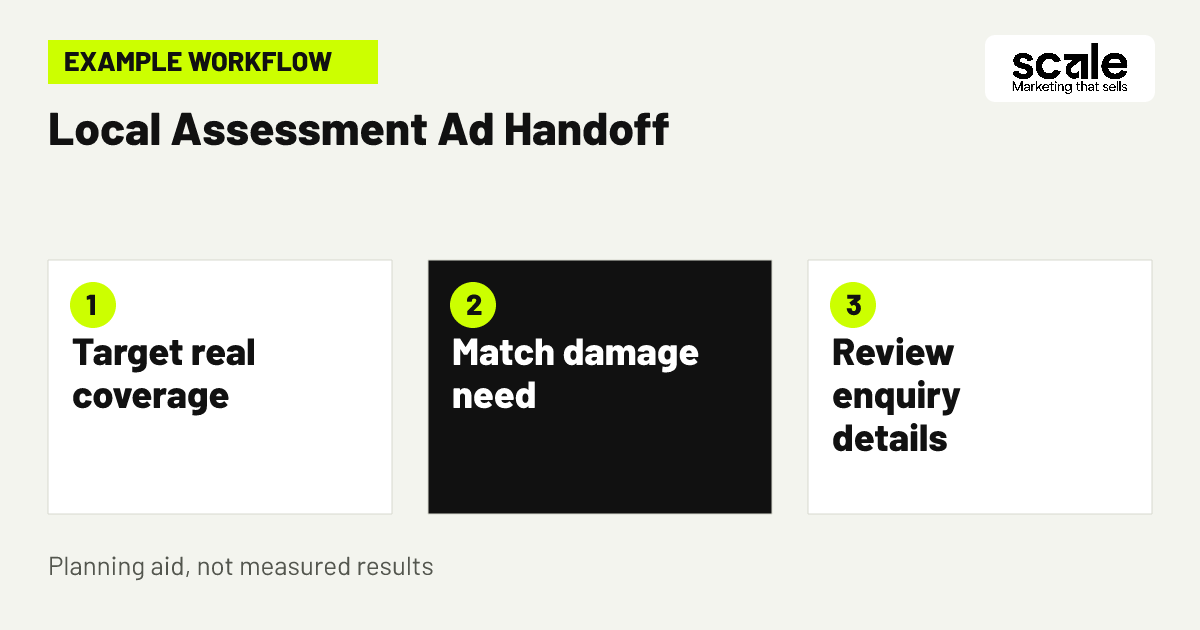
Create separate Search campaigns, or clearly separated campaign groups, for water extraction, drying assessments and mold remediation. This is not complexity for its own sake. It gives each service its own keywords, ad wording, landing page, budget view and enquiry labels.
For example, water extraction ads can focus on requests involving water removal or water-damage assessment, while mold remediation ads can lead to a page explaining the relevant review process. A visitor seeking mold help should not have to work through a generic extraction form to explain their need.
Write a short launch brief for every path: the service need, locations served, landing page, primary contact action, exclusion themes, review owner and reasons an enquiry may not proceed. This gives advertising and enquiry-handling teams the same definition of a useful opportunity.
3. Route an urgent water extraction search to review
Imagine a property owner searching after finding water on a floor. A water-focused ad names the assessment service and the local area it covers. The ad leads to a mobile-friendly page that explains the team will review the property location, damage type and current ability to respond before confirming the next step.
The page asks for the property location, a short description, preferred contact method and whether the request concerns extraction, drying or another listed service. Its confirmation message states that the request was received for review. Staff can then seek clarification, discuss an assessment or explain that the property is outside the service area.
Evaluate this route by checking whether submissions contain enough detail for review and whether staff apply outcomes consistently. If callers still ask whether you handle extraction, improve the ad or page. If many submissions concern mold, strengthen the separate mold route rather than blending distinct needs.
4. Match keywords to the assessment decision
Use keyword themes that describe a problem your advertised assessment can reasonably address. Group close needs only when they share the same service explanation, landing page and lead-review process. Keep broad restoration terms under review because they can bring in requests for work types, locations or expectations your business does not offer.
Read each likely search phrase beside the landing-page heading. If that phrase would reasonably make a visitor expect another service, separate it, rewrite the message or exclude it. This protects relevance before staff need to correct a mistaken first impression.
Review search terms regularly and record why unsuitable themes are not a fit. Negative keywords can exclude selected terms, but they do not automatically cover all close variants or related wording, so additions should be deliberate.
Build an exclusion review without blocking genuine need
Create categories for employment searches, training queries, product-only shopping, non-serviceable locations and services you do not provide. Review both the query and the related enquiry pattern before adding an exclusion. A hurried negative keyword can remove a phrase used by a genuine local property owner.
Use a simple review note
Record the search phrase, campaign, reason it was unsuitable, action taken and date checked. Where intent is unclear rather than plainly irrelevant, improve the ad language or landing page first and review later.
5. Keep ads honest about availability and next steps
Acknowledge urgency without promising an arrival time, accepted job or outcome. Use ad language that identifies the service and invites an assessment request or contact for review. Avoid wording that implies every caller receives immediate dispatch, insurance approval or a predetermined remediation result.
Keep the ad, landing page and first response consistent. If the ad invites a local assessment request, the page should explain which details are reviewed, and the confirmation should not imply that an appointment is already booked. Clear language helps a stressed visitor make an informed contact decision.
Check ads and landing pages on a phone as well as a desktop device. Many property owners search from mobile devices, so the call action, form labels, page layout and service-area explanation should be easy to use without excessive scrolling.
6. Use schedules that reflect who can review demand
Set campaign schedules around times when someone can reliably receive or review enquiries, unless your actual process supports another arrangement. A campaign with no clear owner can create duplicate calls, long waits and expectations your team did not intend to set.
Separate scheduling from bidding decisions. An ad schedule sets the days and times a campaign can show. Manual bid adjustments are handled differently depending on the bidding approach, and automated bidding does not use manual schedule adjustments in the same way. Check the campaign strategy before relying on a bid change.
When capacity changes, update the schedule, call handling and on-page wording as one coordinated change. Review whether enquiries received during each active period get the intended response. If a time window repeatedly creates unhandled demand, reduce exposure until ownership is resolved.
7. Give each service a landing page built for fit
A water extraction page should explain the review route for water-related damage. A mold page should explain the mold remediation enquiry route without suggesting every water issue is a mold job. Service-specific pages help visitors self-select and give staff useful context before the first conversation.
Place the genuine service area, short service explanation and primary contact action near the top. Request only information needed to route a marketing enquiry, such as property location, requested service and contact preference. A longer form is not automatically better if unclear fields stop suitable prospects from submitting it.
SEO Services can help create useful service pages alongside paid search traffic. Avoid copying thin pages for every nearby place or implying offices that do not exist. Accurate coverage information on maintained pages is more useful than a large collection of near-duplicate location pages.
What should the form ask before staff review?
Use a concise request for contact details, property location, service need and a short damage description. Explain that these details help the team review coverage and next steps. Avoid requesting unnecessary sensitive information, and make contact permission and data-use wording easy to understand.
Use careful confirmation language
A suitable confirmation can state: We received your assessment request and will review the location and service details provided. It confirms receipt without claiming acceptance, an arrival time or an insurance decision.
8. Separate water extraction ads from mold remediation ads
Water extraction ads and mold remediation ads should not share one generic destination simply because both relate to property damage. The visitor's concern, service explanation and staff routing may differ. Separate paths make it easier to see which enquiries are appropriate and where the message needs work.
Use distinct copy that names the relevant service, while retaining safeguards that are true for both paths: genuine coverage, review-based wording and a clear contact method. Do not make technical claims that the page or staff process cannot substantiate.
Compare the paths after staff review. If mold enquiries often lack context, improve the mold-page questions. If water-related enquiries frequently request an unavailable service, revise the relevant keywords and exclusions. Address the specific source of mismatch instead of applying the same restriction everywhere.
9. Protect the budget from irrelevant search intent
Search-term review links planned keywords to the demand actually reaching a campaign. Look for repeated themes unrelated to property assessment, extraction, drying or remediation in your coverage area. Use those patterns to decide whether the keyword, negative keyword, ad wording or landing page needs attention.
Negative keywords are useful for excluding unwanted terms, but they require precision. Their match behavior differs from positive keywords, and close variants are not automatically excluded. Record the reason for each meaningful exclusion and watch for unintended loss of suitable enquiries after a change.
Do not use exclusions to hide a landing-page problem. If a legitimate local search reaches the wrong page, send it to the correct service page or revise the campaign structure. Exclusions should remove demand you cannot serve, not conceal unclear messaging.
10. Keep location signals and page qualification aligned
Geographic targeting helps focus ads, but it cannot replace a clear qualification step. Google Ads location targeting is based on signals and best effort, so it should not be treated as proof that every enquiry comes from a serviceable property.
State the restoration service area in plain language on the ad destination and request the property location before staff commit to a next action. This is particularly valuable when you cover selected towns rather than every surrounding area, and it prevents visitors spending time on an unsuitable request.
When reviewing performance, distinguish an out-of-area enquiry from one with an unclear address. The first may point to targeting or page wording. The second may point to form design. Different causes call for different improvements.
11. Connect ad source to staff-reviewed enquiry status
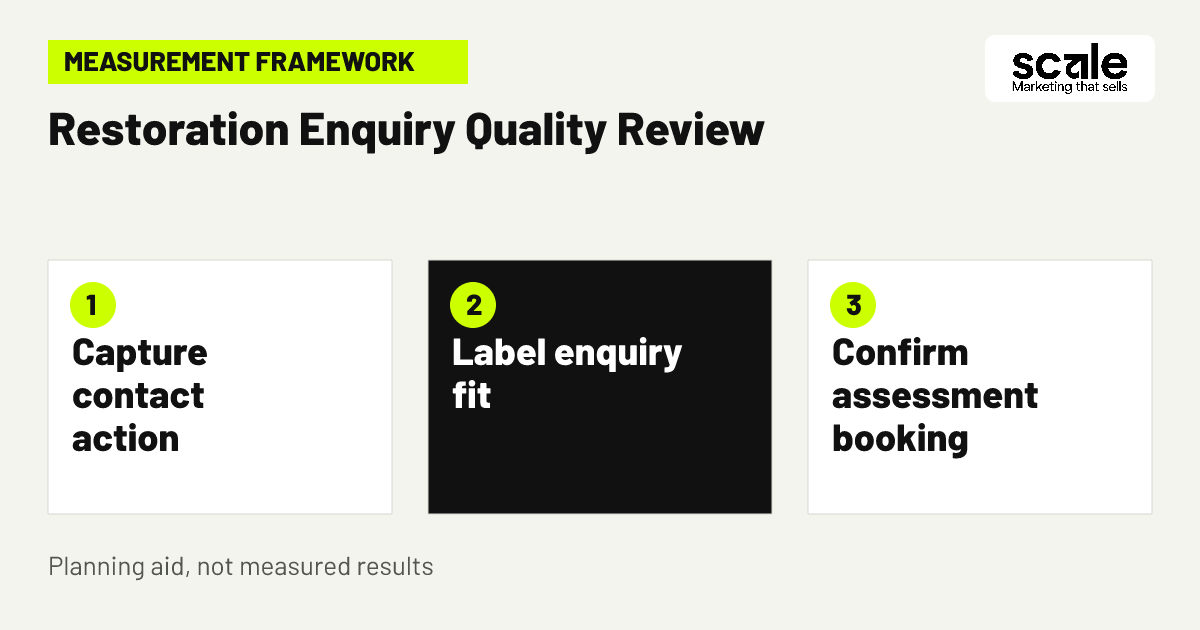
Pass enough source information into the lead record for staff to identify paid search and the selected service path without adding unnecessary reporting work. The reviewer can then classify whether the location, requested service and current response capacity made the enquiry appropriate.
Use a limited set of consistently applied outcomes: suitable for further assessment discussion, outside area, service not offered, insufficient details, unable to respond at that time or another verified reason. The labels matter less than shared definitions and a routine for reviewing them.
AI Implementations can help route an enquiry to the appropriate queue or prepare a receipt acknowledgement for staff review. It should not independently decide a property is accepted, promise dispatch or make important service decisions. A responsible person should remain accountable for those outcomes.
12. Test one campaign change against booked assessment quality
Make documented improvements one at a time rather than changing locations, keywords, ads and forms together. If a water campaign attracts mold enquiries, choose the most likely cause and test a focused change, such as splitting the route, improving the destination page or adding a carefully chosen exclusion. Record the date, reason and expected signal.
A booked restoration assessment is a more meaningful outcome than an unreviewed call or form submission when your team can record it reliably. It connects advertising demand with a real reviewed next step while recognising that location, service fit and availability affect every enquiry.
Configure your website measurement to distinguish completed submissions from earlier actions such as a form start or contact-button click. Then reconcile those events with staff-reviewed lead records. Website activity can show where a visitor acted, but only your review process can confirm whether the request was suitable and became a booked restoration assessment.
Marketing mistakes that create busy phones but weak-fit leads
A common mistake is running one all-purpose restoration campaign. It may attract many searches, but its ads and destination page cannot clearly answer whether the visitor needs extraction, drying or mold work. Investigate when staff repeatedly need to identify the basic service after contact, or when one route receives enquiries intended for another.
Another mistake is treating a location setting as a guarantee that every request is from a serviceable property. Confirm property location during the request process and compare out-of-area outcomes with the campaign's actual targets. Correct the targeting, wording or form field creating the mismatch.
A final mistake is counting every call, phone click or form submission as a successful lead. These are useful early signals, but they can include incomplete requests, accidental taps, unsupported services and missed follow-up. Review records with the people handling enquiries before expanding a campaign.
Measure fit, response ownership and booked assessments
Track a short funnel that mirrors the real journey: relevant landing-page view, contact action, completed submission or tracked call action, staff-reviewed fit and booked restoration assessment. Define the event and owner for each stage before adding it to a report. A form completion is a website interaction, while suitability is a staff-reviewed business outcome.
Read the signals together. High traffic with few contact actions may mean the ad promise and page do not match, or the primary action is unclear. Many submissions marked outside area may indicate a targeting or service-area-language issue. Suitable enquiries that do not progress may reveal an unowned handoff, missing details or a capacity constraint.
Prioritise the earliest point where useful demand is lost. Repair broken contact routes and delayed review first, then clarify coverage and service fit, then refine search terms and campaign structure. Do not increase budget simply because top-of-funnel actions rise; first check whether the change improves the quality of enquiries reaching the booked stage.
Conclusion: build campaigns around requests you can review
The strongest water damage Google Ads tips build a practical local path: target areas you can support, separate service needs, make review conditions visible and measure whether appropriate enquiries become a booked restoration assessment. This helps protect team capacity while giving property owners a clearer next step.
Choose one active search path and audit it today. Compare its targeted locations, keyword theme, ad wording, landing page, confirmation message and staff outcome labels. Correct the largest mismatch first, then review new enquiries to determine whether the handoff is clearer.
Related resources
Water Damage & Mold Restoration Marketing · Google Ads Management · SEO Services · AI Implementations · 10 Water Damage Website Conversion Tips to Book Assessments