
Can LinkedIn create SaaS demos your team can use?
SaaS LinkedIn advertising tips are most useful when they help a sales-led software business earn conversations with people who have a credible reason to assess the product. This guide is for SaaS founders, growth leads and demand-generation teams deciding whether professional targeting can support qualified demos. The direct answer is yes when you know the buyer, can explain fit clearly and have a reliable path for screening and follow-up.
LinkedIn is often suitable where a product solves a defined business problem, several people influence the purchase and the likely value of a customer can justify a considered acquisition process. It is less suitable as a shortcut for an unclear offer, a very broad consumer audience or a team unable to respond to enquiries. Before launch, agree what counts as a useful conversation, which markets sales can cover and whether a demo is genuinely the right next action for each audience.
1. Define the demo your sales team wants
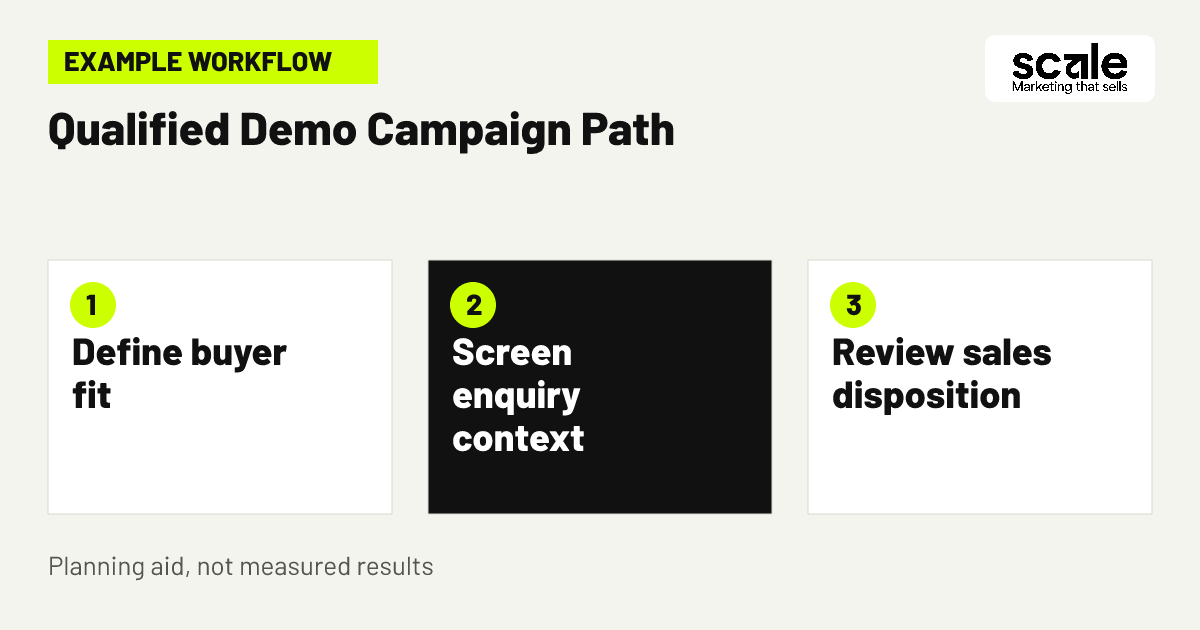
Write a short qualification statement before creating a campaign. Include the business role or team, the recurring problem, the type of organisation, the expected use of the software and why a guided conversation is appropriate. Avoid vague labels such as enterprise lead or decision-maker. A shared definition prevents marketing from pursuing form volume that sales does not recognise as useful.
For example, workflow software may seek operations leaders who need a repeatable approval process involving several teams, rather than anyone interested in productivity tools. Review a small selection of accepted and declined conversations with sales. If the reason for acceptance cannot be described consistently, improve the definition before spending more on acquisition.
2. Build audiences from buying roles, not job-title lists
Start B2B SaaS audience targeting with a buying-role hypothesis: who experiences the problem, who evaluates the workflow and who can approve a change. LinkedIn provides audience attributes including job title, function and industry, but combining every possible filter can make an audience too narrow to learn from. Use the fewest criteria needed to express a meaningful business context.
Create separate audience notes for each group. Record the proposed role, company context, pain point, message angle, destination and exclusion reason. Check whether the same person could plausibly appear in more than one group. If so, clarify the role of each campaign rather than allowing overlapping activity to obscure what message is being tested.
Choose one account context
Decide whether company size, industry or another business context materially changes product fit. A useful filter reflects how the product is bought or used, not a desire to make the audience look precise. If different contexts need different proof, create distinct paths rather than using one generic ad for all.
Check the sales coverage boundary
Confirm that the sales team can support the markets, languages and account types selected. A targeting choice is not complete until the business can give an appropriate response to the resulting enquiry.
3. Map each audience to one credible problem
Example: a SaaS platform helps larger teams standardise approval requests. One campaign can address operations leaders responsible for a fragmented process, while another addresses finance leaders concerned with visibility and ownership. Both may buy the same software, but each needs different opening language, proof and qualification question.
Do not claim that either audience is automatically ready for a demo. Send each to a page or lead form that states the workflow the product supports and what the conversation will cover. Evaluate the scenario by comparing accepted conversations, stated use cases and recurring mismatches by audience, not by assuming the group with more submissions is stronger.
4. Make the ad clarify the product boundary
An ad should qualify as well as attract attention. Name the operational problem, the intended business setting and the next action without implying that the product solves every adjacent need. If implementation requires multiple teams, a particular workflow or a guided evaluation, say enough to set an honest expectation before a visitor submits details.
Read the ad beside the destination page and the first sales email. The promise should remain consistent throughout. If sales hears that prospects expected a different category of software, diagnose the wording first. Broader language may increase curiosity, but it can also create conversations that were never suitable.
5. Match the conversion route to buying readiness
A demo is not the right request for every person reached through professional advertising. A mature buying group assessing a complex process may need a conversation, while an independent user may be better served by a trial or a useful product explanation. Choose the route based on the product's route to revenue and the help needed to evaluate fit.
Keep these actions separate in reporting. A content download, trial start and demo request indicate different levels of intent and should not be merged into a single lead count. Review whether each route produces the expected next-stage behaviour, then make the call to action clearer where visitors choose an inappropriate path.
6. Design lead forms for useful sales context
LinkedIn lead form quality improves when each question has a practical use after submission. Ask only for context that changes routing, preparation or the next action, such as role, organisation, team situation or main use case. A long form can create friction, while a form with no fit questions leaves sales to discover basic context too late.
Write the form as a compact screening brief. The headline should state the offer, the description should explain what the prospect receives and each field should answer a known sales question. Apply your normal privacy and consent review before launch. If a field is never used, remove it; if sales repeatedly lacks essential context, revise the question.
Separate routing from qualification
Not every field must determine whether somebody deserves a reply. Some answers simply help route a prospect to the right person or resource. Reserve hard qualification for conditions that make a demo genuinely unsuitable, and provide a respectful alternative route where possible.
7. Use landing pages when buyers need evidence
A native form can reduce the steps to enquiry, but it cannot replace information a considered buyer needs before speaking to sales. Use a landing page where prospects need to understand the workflow, intended users, relevant integration limits or evaluation process. The page should help people recognise fit, not hide the product behind a calendar request.
Check the route on desktop and mobile as a prospective buyer would. Can a visitor understand what the software does, who it is for and what happens after the action? If sales receives basic questions the page should answer, improve the explanation before adding more targeting layers.
8. Exclude audiences for a specific business reason
Exclusions are useful when they prevent an obvious mismatch, such as people seeking employment, vendors, existing customers needing support or roles that cannot use the product. Record why each exclusion exists and where it applies. Avoid excluding a broad function merely because one enquiry was unsuitable; that can remove people who influence a legitimate purchase.
Inspect rejected enquiries for patterns in role, company context and stated need. If the pattern is clear, update targeting or the message. If the pattern is mixed, the problem may be unclear positioning rather than the audience itself. Revisit exclusions when the product, market or sales model changes.
9. Align campaign timing with response ownership
Choose a schedule that the team can support, especially if the ad implies a prompt discussion. Name an owner for incoming enquiries, a backup owner and a route for enquiries that arrive outside normal coverage. This is not about assuming a universal best time to advertise; it is about avoiding a gap between expressed interest and a meaningful response.
Check the handoff from the form or page to the customer record system before launch. Run a test submission, confirm notification delivery and ensure the owner can see the source, campaign and answers. A broken or ambiguous handoff can make a sound targeting decision appear ineffective.
10. Give sales a concise conversation brief
The demo follow-up process should give sales the information needed to continue the promise made in the campaign. Pass the ad theme, audience group, requested offer, form responses and landing-page route where available. This helps the first message refer to the prospect's likely problem instead of treating every enquiry as identical.
Agree a small set of next actions: invite to a suitable demo, direct to a trial, share a relevant resource, clarify a requirement or close as unsuitable. The purpose is not to automate a generic reply. It is to make a timely, informed response easier while preserving a clear record of what happened.
11. Use sales dispositions to improve the next campaign
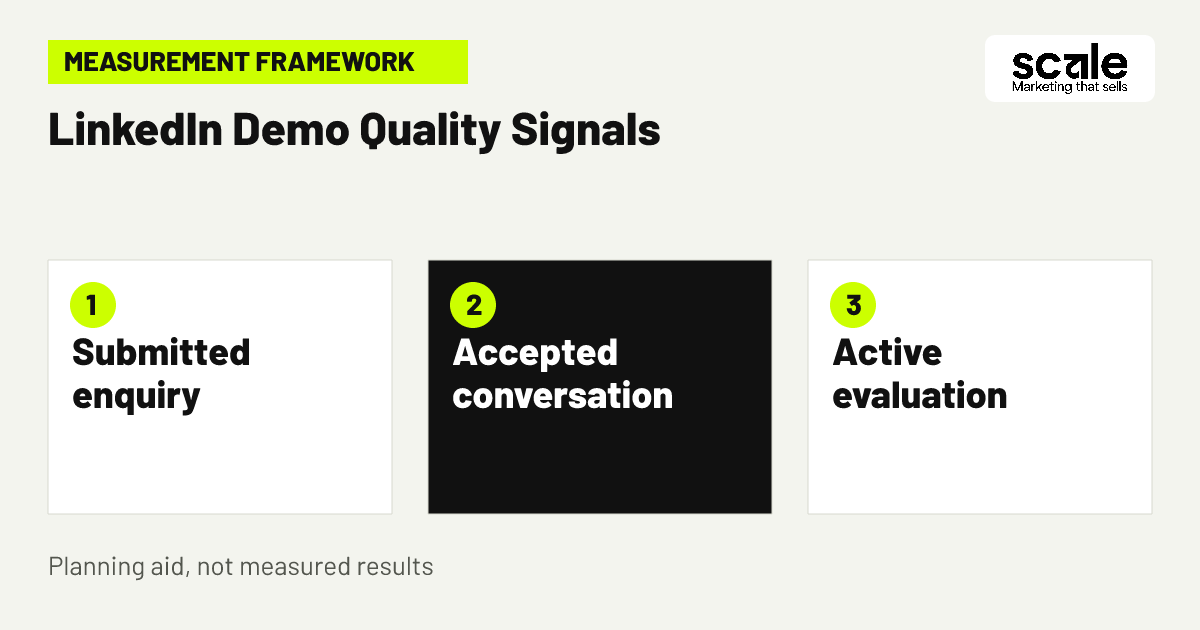
Set up simple outcome labels that sales can apply consistently, such as accepted conversation, wrong use case, unsuitable company context, no response, trial route or active evaluation. A free-text note can add detail, but the core labels need to remain stable enough to compare campaign patterns over time.
Review labels jointly rather than treating a rejection as automatic evidence that marketing failed. A no-response outcome says little about product fit, while repeated wrong-use-case labels may point to an ad or form problem. Use the earliest repeated mismatch to decide whether to change audience, message, page, question or follow-up.
12. Test one qualification change at a time
Write a plain-language hypothesis before a test: which audience, message or form element is expected to reduce a specific mismatch, and what signal will show whether it helped. Keep the other major parts of the route stable where practical. Changing targeting, creative, form fields and sales handling at once makes the learning unusable.
For example, if several prospects expect a lightweight personal tool, test an ad that names the team workflow and a form question about the current process. Then inspect submitted answers and sales dispositions. Retain a change because it improves evidence of fit, not because it creates an attractive surface-level campaign metric.
13. Compare LinkedIn with the job it must do
Judge this channel against the business decision it supports, not against a universal benchmark. Professional targeting can be valuable when the audience is defined and sales needs a focused way to start relevant conversations. Paid search may be more appropriate for people already expressing an urgent problem, while SEO can support buyers who need time to understand a category or comparison.
Keep channel roles distinct. Do not use a LinkedIn lead form to claim the value of organic content, and do not expect an early research audience to behave like a high-intent searcher. Compare the quality of later sales signals, the effort required to manage the channel and the business's capacity to act on demand.
Marketing mistakes that fill calendars with poor-fit demos
The most common mistake is treating every submitted form as a successful outcome. Others include layering too many filters without a buyer hypothesis, using generic transformation language, asking questions sales ignores and sending leads to an unowned inbox. These errors can produce tidy platform reports while creating a poor experience for prospects and sales.
Diagnose the full route in order: audience definition, ad promise, page or form, record handoff, first response and sales disposition. Irrelevant roles may point to targeting. Relevant roles expecting the wrong product point to message or page clarity. Suitable prospects who receive no useful response point to the handoff, not the campaign.
Measure movement from enquiry to suitable conversation
Measure a chain rather than a single lead total: ad engagement, page or form progression, submitted enquiry, response ownership, accepted conversation, evaluation stage and later customer-record outcomes where they can be connected responsibly. Define each stage before reporting. A submitted form is an action; it is not proof that a prospect is a good fit.
Website analytics events can measure user interactions such as page views, link clicks and form-related actions when implemented correctly. Test events before relying on them, use consistent names and inspect the data for missing or duplicate signals. Combine this on-site activity with the sales disposition rather than asking analytics alone to decide lead quality.
Prioritise the earliest recurring weak signal. Low interaction may mean the audience or message is unconvincing. Strong form completion with frequent rejection can indicate unclear fit. Accepted conversations with slow follow-up require an operational fix before additional campaign expansion. Outcomes vary, so use repeated patterns and documented definitions.
What should teams measure after improving follow-up?
After changing the demo follow-up process, examine whether each enquiry has a recorded owner, whether the intended first action happened, which outcome sales selected and whether recurring reasons for rejection changed. Also check whether useful conversations have enough campaign context for sales to continue the discussion appropriately.
Keep uncertainty visible
Where campaign and customer records cannot be matched, mark the gap rather than assigning an outcome by assumption. Honest incomplete data is more useful than a report that makes unrelated records appear connected.
Conclusion: make qualification a connected campaign decision
Qualified SaaS demos come from a connected system: a precise buyer hypothesis, clear product boundaries, a suitable conversion route and feedback from the conversation that follows. LinkedIn can be a sensible channel when that system exists and the sales team has capacity to respond. It is not a replacement for knowing who the product serves.
Start with one campaign audit. Write the qualified-demo definition, trace a recent enquiry from ad to sales outcome and identify the first repeated mismatch. Fix that one point, document the expected signal and review the next group of enquiries with sales before making broader changes.
Related resources
SaaS Marketing · Paid Search · LinkedIn Advertising · SEO Services · 11 SaaS SEO Ideas to Attract Comparison-Ready Buyers · 12 SaaS Google Ads Tips to Improve Demo Quality