
Choose coverage your business can genuinely serve
Google Local Services Ads service area targeting works best when the selected locations reflect where you can respond promptly, complete suitable work and maintain a consistent customer experience. This guide is for service businesses considering Local Services Ads availability in their category and location, and for advertisers whose enquiries become less suitable as their map expands. The direct answer is to begin with your strongest operational area, then widen only after lead records show that additional places bring work worth accepting.
Local Services Ads can show when people search for offered services in areas a business has chosen, with leads arriving by calls or messages. That makes geography a business decision, not merely a setting. Check eligibility before planning coverage, because category and location availability varies. Also confirm that the services in your profile match the work your team wants, since relevance to the search and profile information can affect how the ad is considered. Scale's Google Local Services Ads service can help structure this review without treating a larger footprint as an automatic improvement.
1. Draw the first boundary around response capacity
Choose an initial boundary from your real ability to answer, travel and schedule work. List the communities you can reach during normal operating conditions, then flag places where traffic, distance, staffing gaps or appointment windows routinely make arrival uncertain. A smaller, dependable area is usually a better starting point than broad coverage that creates calls you must decline. This is the foundation for sensible Local Services Ads locations.
Why it can help: customers contacting a local provider expect a practical path to service. If your team can answer and confidently accept the request, the enquiry has a clearer chance of becoming booked work. For example, a plumber with technicians clustered near two neighbouring towns may start there rather than include every suburb surrounding the metro area. Review accepted versus declined enquiries and the reason for each decline after the launch period; repeated distance-related declines mean the boundary is too wide.
2. Match each covered place to a service promise
For every place you intend to cover, identify the specific services, customer type and timing you can support there. A useful plain-language brief says: “We serve homeowners in these communities for planned repairs and urgent callouts during staffed hours; larger projects require an assessment before scheduling.” This prevents a map from promising broader availability than operations can deliver. Check that the profile's selected services, business description and team instructions tell the same story.
Why it can help: a precise promise filters out some mismatched requests before staff invest time chasing them. A cleaning business, for instance, may serve nearby residential areas for recurring home cleaning but exclude one-off commercial work outside its route. Ask the person answering enquiries to tag whether the caller understood the offer, then compare that tag by area. If a location produces confusion about scope, refine the service explanation or remove that location until the promise is realistic.
Give the enquiry team an area-handling script
Write a short response guide before ads run. It should state how to verify the customer’s location, how to confirm the requested service and when to offer the nearest suitable appointment. Staff should not guess whether an edge-of-area request is viable; they need a clear escalation path for locations that fall outside normal coverage.
Sample internal check
“Can we serve the address within our stated operating conditions? Is the requested job one we advertise? If either answer is no, record the reason and close the enquiry courteously.” These notes turn vague complaints about poor lead quality into evidence for later map decisions.
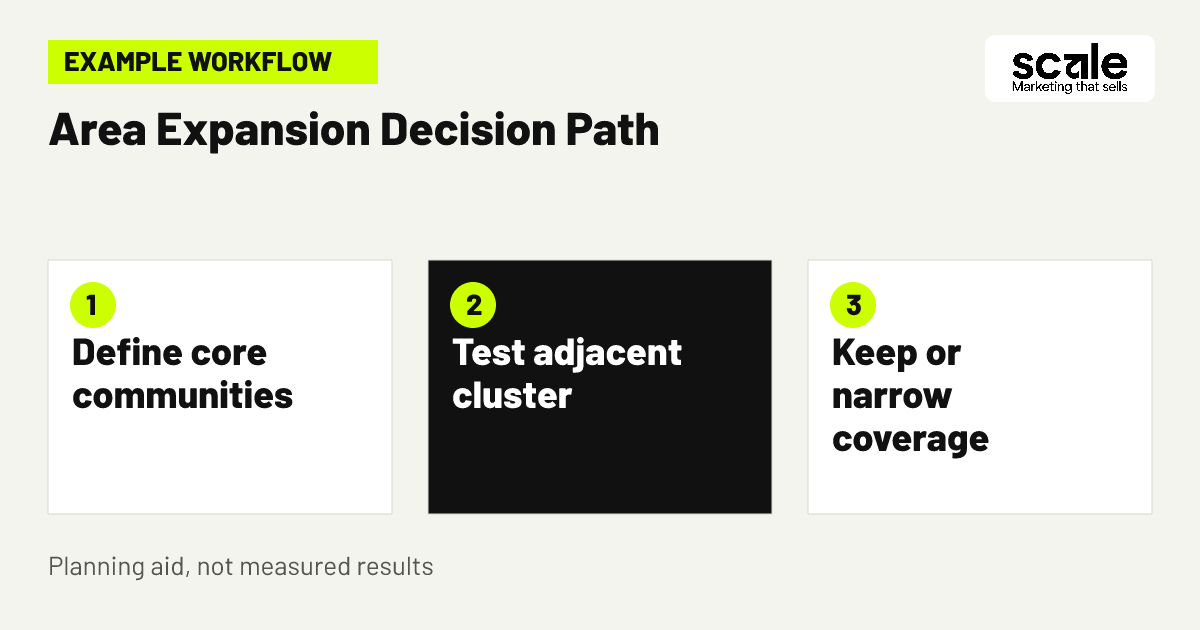
3. Test one adjacent cluster before widening broadly
Example: a home repair business already serves its home town and several nearby communities with reliable schedules. Rather than turning on a large surrounding region, it adds one adjacent cluster whose travel routes are familiar. The business keeps the advertised service mix unchanged, uses the same lead-handling process and records enquiries from the new cluster separately. That setup makes the geographic change easier to evaluate.
Why it can help: a focused test reveals whether the new area produces requests that fit your business without mixing the outcome with many other changes. Review whether people in that cluster ask for your listed services, whether staff can contact them quickly and whether travel complicates fulfilment. If suitable enquiries are consistently manageable, the next neighbouring cluster may be considered. If requests regularly fall outside scope or make scheduling impractical, restore the tighter boundary rather than trying to compensate with a vague, larger service area.
4. Use travel routes, not straight-line distance
A map can make two locations look close even when bridges, major roads, parking constraints or seasonal conditions make the trip difficult. Build service area advertising around actual travel routes and appointment density. Ask dispatch or field staff which neighbourhoods can be grouped into an efficient daily route and which ones create isolated journeys. Include setup and return-travel realities, not only the outward trip.
Why it can help: coverage that follows workable routes can preserve capacity for the customers already in your core area. An electrician might comfortably serve communities along one corridor but avoid a similarly distant location reached by an unreliable cross-town route. Evaluate this decision using staff notes, late-arrival patterns and the number of jobs that require awkward schedule gaps. Where route friction is common, restrict coverage or only accept that location when the request fits planned availability.
5. Protect your core area during busy periods
Your best geographic plan can change with staffing levels, weather, demand cycles and booked workload. Decide in advance what triggers a temporary reduction in coverage: a full diary, a technician absence, a backlog of messages or repeated inability to offer a reasonable appointment. Local Services Ads accounts can be paused when the business is too busy to accept leads, so availability should be actively managed rather than left to chance.
Why it can help: protecting core customers avoids paying attention to work you cannot handle well. A tree service may focus on nearby urgent enquiries while its crews are committed, then reopen an outer location once capacity returns. Review the number of enquiries declined due to availability alongside response handling. If outer-area leads are frequently declined during peak demand, use a narrower active area during those periods instead of allowing the same map all year.
6. Let job value and complexity shape the map
Not every service can support the same travel commitment. Separate work that can be planned efficiently from work that needs fast attendance, specialist equipment or a site visit before a firm commitment. Then decide where each type of request remains practical. Do not imply a service is available everywhere simply because some jobs can justify a longer journey.
Why it can help: this turns local customer targeting into a deliberate fit decision. A roofing business may accept assessment requests across a wider practical region but limit urgent repair calls to areas crews can reach promptly. Review the eventual job type, required resources and travel burden for each enquiry. If a distant location only creates complex requests that disrupt the schedule, it does not belong in the same active coverage test as straightforward nearby work.
7. Avoid overlapping locations that compete internally
If your business has more than one location serving the same geography, decide which location should own each practical area. Local Services Ads may show only the highest-ranked ad when multiple business locations serve the same geographic area. Duplicating coverage is therefore not a reliable way to create more visibility, and it can obscure accountability for call handling and scheduling.
Why it can help: clear ownership gives each team a defined service promise. A multi-location contractor can assign communities based on the depot, crew and route most likely to fulfil the work, rather than allow both offices to claim everything. Review each location's enquiry records and operational handoffs. If calls are regularly transferred between locations or teams dispute who should respond, redraw the boundaries and publish the ownership rule internally.
8. Keep the profile relevant to each local search
Geography alone does not make an ad a good match. Confirm that your selected services, business information, images and review process support the kind of customer you want in each area. Local Services Ads ranking takes account of the search context, including location, and of the relevance and overall quality of a provider profile. Complete required verification steps and keep the profile accurate before blaming an area for weak enquiry quality.
Why it can help: a trustworthy, specific profile gives prospects context before they contact you. A pest control business serving rural communities, for example, should ensure its advertised services match the treatments it can actually provide there. Review message themes and call notes for signs that people expected an unoffered service. When that happens, correct the profile or service selection first; do not assume that expanding or contracting the map alone will solve a relevance problem.
9. Treat missed contacts as a coverage warning
An outer area is not workable if the business cannot respond to the people it attracts. Google notes that missed calls and poor responsiveness can negatively affect responsiveness, while message or booking options, where available, can give customers another way to contact a business. Check what contact methods are available and appropriate for your category, but build the plan around a real owner for every incoming request.
Why it can help: quick, consistent acknowledgement helps prevent a promising local enquiry from going cold. A locksmith should arrange coverage for calls during the hours it advertises; a planned-service business may instead assign message monitoring and clear follow-up windows. Review unanswered calls, delayed responses and the locations associated with them. If outer areas generate contacts when no one can handle them, narrow travel radius lead coverage or change internal availability before seeking more reach.
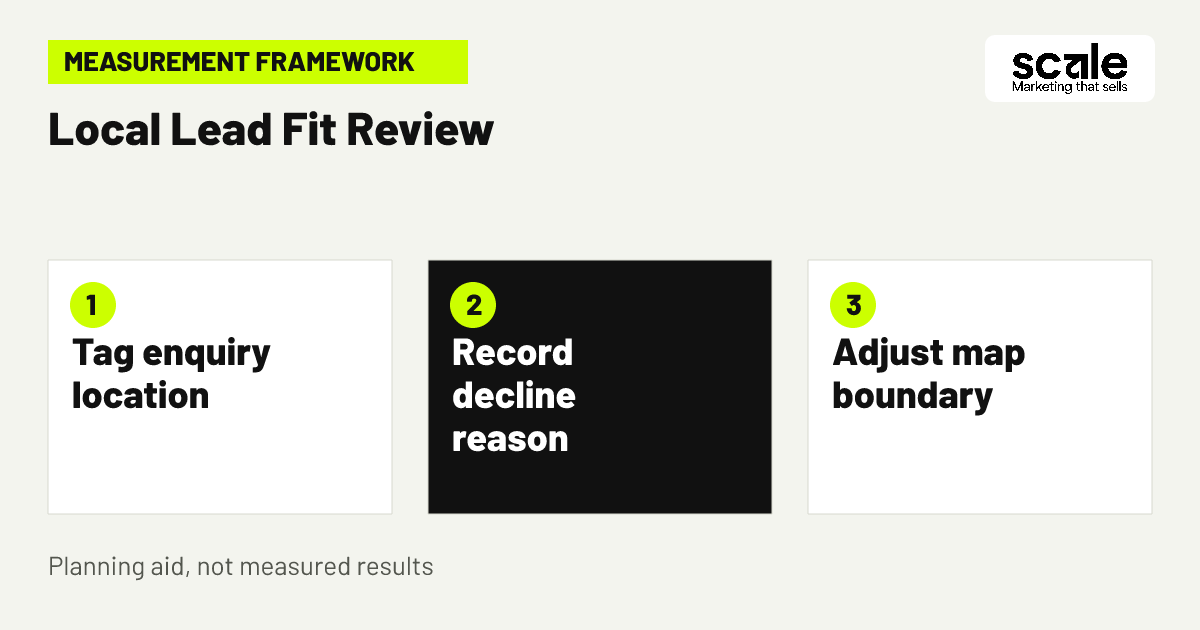
10. Record why each lead was accepted or declined
Create a simple lead log with the customer's area, requested service, contact method, response status, outcome and a plain-language reason for acceptance or decline. Keep the reason categories useful: outside coverage, unsuitable service, unavailable timing, duplicate enquiry, unreachable customer or viable opportunity. Do not rely on staff memory or an overall feeling that a neighbourhood is poor quality.
Why it can help: recorded reasons identify the actual constraint. A garage door business may discover that an outer postcode generates appropriate repair requests but the team declines them only on days with no route capacity. That calls for availability planning, not necessarily a permanent exclusion. Review the log after enough normal operating activity to see patterns, and compare areas only when the service offer and handling process were broadly consistent.
11. Change one geographic variable at a time
When testing coverage, avoid changing the map, advertised services, staffing process and profile wording all at once. Choose one bounded change, document the date and state what you expect to learn. For example: add one group of adjacent communities while keeping operating hours, service selection and lead response ownership unchanged. This makes the result interpretable even when demand naturally varies.
Why it can help: controlled adjustments prevent the wrong conclusion. If lead fit worsens after several simultaneous changes, no one knows whether the problem came from distance, service messaging or unanswered calls. Review the lead log and operational notes against the documented change. Keep a change only if it produces manageable, suitable enquiries without weakening service in the core area; outcomes vary, so use your own records rather than a universal map size.
Marketing mistakes that make a service map less useful
The most common mistake is selecting a broad area because it contains more people, without checking whether it contains customers you can serve profitably and promptly. Another is treating every call as proof the area is working. A high volume of unsuitable or declined enquiries can consume staff attention while adding little useful demand. Diagnose this by looking at decline reasons by place, not at total contacts alone.
A second mistake is leaving an outdated map active after teams, routes or service scope change. Businesses also overlook the profile-to-operations gap: the profile suggests availability, but the person answering calls cannot honour it. Fix the basics before expanding again. Confirm eligibility, profile accuracy, verification requirements, service selection, coverage ownership and lead-response responsibility. Local Services Ads are not a fit if your business cannot consistently answer enquiries or lacks a practical way to serve the selected areas.
Do not confuse a service area with a delivery promise
A service area indicates where you seek relevant enquiries; it should not encourage blanket claims that every job can receive identical timing or scope. Set customer expectations through honest descriptions and confirm location and job details before committing. This is especially important for urgent, regulated or safety-sensitive service categories.
How to spot the mismatch
Look for recurring conversations where staff must retract an apparent promise, redirect a caller or explain that a requested service is unavailable. Those are profile, process or coverage design signals, not simply “bad leads.”
Measure fit, response and fulfilment before expansion
Track geographic performance through a compact weekly review. For each area, count incoming calls and messages, then classify whether the request was suitable, contacted promptly, accepted for follow-up, booked where that feature is available, completed or declined. Pair those records with the decline reason and a travel or scheduling note. Google provides lead management and reporting tools, and businesses can track bookings in supported regions, but your own operational notes supply the context a dashboard cannot infer.
The key signals are practical. More suitable enquiries with manageable travel suggest an area is worth retaining. A rising share of outside-scope calls points to a profile or service-selection problem. Suitable enquiries with delayed contact indicate a staffing or notification issue. Repeated accepted jobs that strain routes indicate a capacity limit. Act on the limiting signal: revise the offer, improve response ownership, reduce the active area or plan routes differently. Prioritize the change that removes the most repeated reason for lost or declined work, then reassess before making another expansion.
Conclusion: build outward from dependable local coverage
The right map for Google Local Services Ads is the one your business can support with accurate services, responsive handling and workable travel. Start with core communities, define what each area can reasonably expect, and use lead reasons rather than assumptions to decide whether to expand. The most practical next action is to create the area-by-area lead log and have the person handling enquiries use it from the first day of a coverage test.
If eligibility and your operating model support Local Services Ads, review the profile and coverage plan together before changing locations. Scale's relevant service focuses on eligibility, verification, service-area targeting and lead quality, while final coverage decisions should remain grounded in your team capacity and customer fit.