
A charger quote page should qualify without blocking genuine leads
Electrician website conversion tips for EV charger work are most useful when your website must turn interest into enquiries your crew can actually assess and serve. The direct answer is to create a focused route from charger-related searches to a clear service page, a short but useful enquiry form, and a defined human follow-up process. This guide is for local electrical businesses that want more suitable EV charger conversations rather than a larger pile of vague calls.
An EV installation is usually a considered project, not the same decision as an urgent loss-of-power call. Visitors may be comparing installers, checking whether their property is suitable or trying to understand what information an electrician needs. Your site should help them take the next sensible step while making clear where you work and what type of installation enquiries you handle. It should not imply a site visit, availability or a completed assessment before someone has reviewed the request.
1. Decide which charger enquiries your website is built to win
Before changing a form or call button, define the jobs that fit your crew, coverage and scheduling. Decide whether the page is intended for homeowners, landlords, workplaces or another audience you genuinely serve. Be equally clear about the areas you cover and whether you want enquiries for a new installation, a replacement, an upgrade assessment or a fault related to existing charging equipment. This protects staff time and gives prospects a more accurate expectation.
Write a one-paragraph service promise from the visitor's point of view: explain the kind of charger project you can discuss, the broad information needed for a quote and what happens after they enquire. Avoid broad claims that every property can be priced online. Electrical conditions and property layouts vary, so the website should invite an assessment rather than overstate certainty.
A useful decision rule is to make one primary page for planned charger projects and keep urgent repair messaging separate. Someone with a possible electrical fault needs a response path that reflects your advertised hours; someone researching a charger should not be pushed into an emergency route. This distinction can also guide separate Google Ads landing pages and local SEO service content, so the message matches the visitor's purpose.
Match the promise to your real service area
List the towns or neighbourhoods you serve only where your team can attend. Put this context near the enquiry action, not hidden in a footer. Accurate coverage prevents avoidable submissions and is more credible than copying the same promise across places you do not serve.
A simple fit statement
Sample wording: Request an EV charger installation assessment for a property within our service area. Tell us the property type, location and preferred contact method, and our team will review the enquiry before confirming the appropriate next step.
2. Build an EV charger quote page around buyer questions
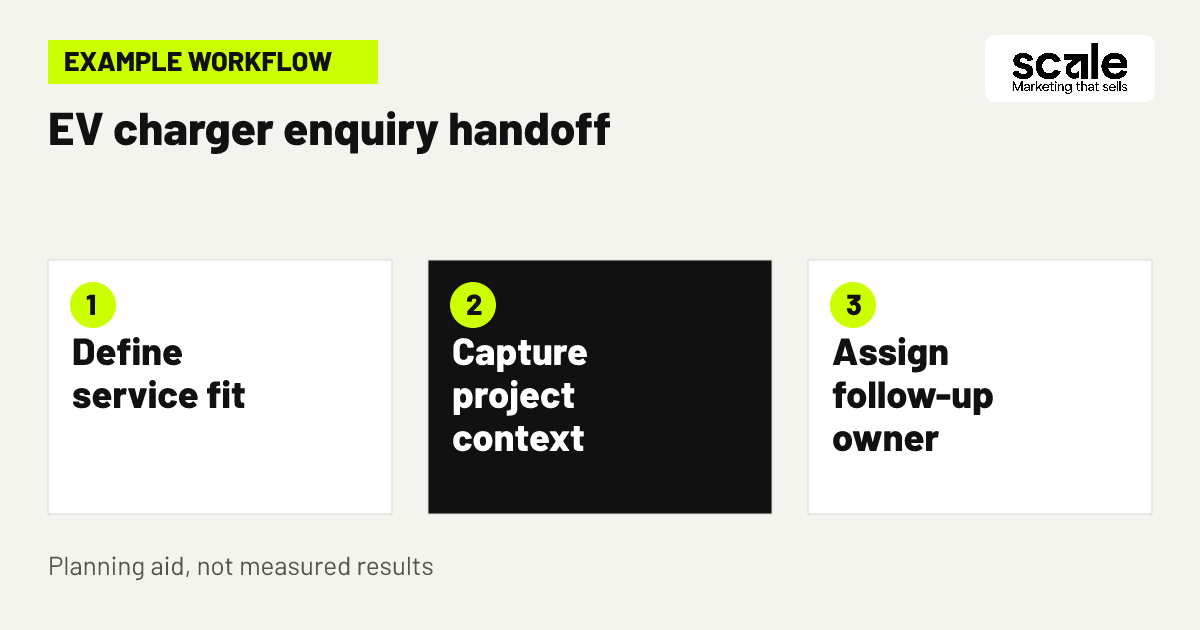
An EV charger quote page should answer the questions that stop a ready prospect from enquiring: what type of property you work on, where you operate, what information helps you assess the project and what response they can expect. Give the page one prominent enquiry action near the opening explanation and repeat it after useful supporting details. The action should describe the outcome, such as Request a charger installation assessment, rather than relying on a vague Submit label.
Ask only for information that will change how your team handles the enquiry. A practical form can request name, contact details, property address or area, property type, whether the charger is for an existing or planned vehicle, a brief project description and the preferred contact time. An optional photo upload may be useful only if your process can receive and review it safely. Explain why you request any extra field, especially where it could feel intrusive.
Check the page on a phone before publishing. The form must be readable, easy to complete and followed by a confirmation message that says the enquiry was received. Google’s guidance notes that mobile-friendly ads and websites matter because many searches take place on mobile devices. Do not make a visitor hunt for the phone number, but make clear that calls are for the situations and hours your business can support.
3. Route every request to a next step your team can deliver
Create electrician enquiry routing rules before increasing traffic. The rule does not need to be complicated: charger installation requests within your coverage go to the person who can check project details and arrange the appropriate follow-up; repair-related messages go to the repair process; locations outside coverage receive a polite boundary message. The important point is that every form choice has an owner and a response expectation.
Example: A homeowner arrives after searching for a home charging installation. They choose a residential property, provide their area, explain that parking is off-street and request contact in the afternoon. The page confirmation says the team will review the request and contact them about the next step. The lead is then labelled Charger residential, checked against coverage and passed to the staff member who handles planned installation enquiries. No page message claims that a price or appointment has already been confirmed.
This approach also makes paid search easier to govern. Charger-focused ads can lead to the charger page, while ads for repairs lead to a repair page with different wording and contact expectations. Google Ads is an advertising program for reaching people looking for businesses, but the visitor’s post-click experience must still do the work of qualifying and converting the enquiry.
4. Use calls to action that state the right commitment
Charger installation calls to action should tell visitors what they receive by acting now, without promising an outcome that depends on assessment. Good choices include Request an installation assessment, Discuss your charger project or Ask for a charger quote review. Place the main action beside a short explanation of what to have ready, then repeat it after the service details for people who need more confidence before enquiring.
Avoid mixing competing commitments in the same visual space. A page with Call now, Get a quote, Book online, Emergency help and Contact us gives no priority to the planned charger visitor. Choose one main action and one support option, such as a clearly labelled phone call. If you advertise specific hours, keep the wording aligned with who can answer at those times.
Evaluate the action by looking beyond clicks. If many people begin the form but few finish it, the request may be too demanding or unclear. If completed forms are routinely missing the one detail staff need, add a plain-language prompt rather than making the whole form longer.
5. Give prospects enough detail to enquire with confidence
A conversion page should reduce uncertainty, not try to teach every technical detail of charging equipment. Explain your process in plain English: send project details, the team checks whether the request fits its coverage and service, then you discuss the appropriate assessment or estimate process. Include genuine qualifications only when you can substantiate them, and never invent local offices or coverage to appear more established.
Use practical prompts that help a visitor describe the site. For example, ask whether the property is a house, apartment, rental or workplace; whether parking is close to the electrical supply; and whether they are planning a new charger or replacing an existing unit. These prompts improve the conversation without asking the customer to diagnose electrical work.
Keep the page focused on the job you want to promote. A short link to your broader electrical services is enough for someone with another need. Large lists of unrelated services can distract a visitor who came specifically to enquire about EV charging.
6. Connect local visibility to a page that matches intent
Local SEO content and business details should lead people to a page that reflects the service they searched for. A general electrician homepage may be suitable for broad brand searches, but a person considering a charger installation benefits from a dedicated route with charger-specific questions and a relevant contact action. Ensure service areas are consistent between the page and the business information you control.
For paid campaigns, group charger search intent separately from repairs, rewiring or panel-related work so each destination can use the right language. This is not just a traffic decision. It makes it possible to identify whether a problem comes from the search message, the landing page or the follow-up process. Review search terms and enquiries together, removing attention from irrelevant intent rather than trying to convert everyone.
Do not assume every area name deserves its own near-duplicate page. Create useful local pages only when they add real location-specific service information and reflect genuine coverage. A smaller set of accurate pages is easier to maintain and less likely to create misleading expectations.
7. Make estimate follow-up part of the website journey
An enquiry conversion is incomplete when a submitted form disappears into an inbox. Define electrical estimate follow-up as a visible process: acknowledge receipt, review fit and completeness, make contact through the stated channel, record whether an estimate is needed and remind the responsible person about open estimates. The website confirmation should set expectations carefully rather than saying an electrician is on the way.
Decide what staff should do with incomplete requests. A missing phone number, address outside the service area or unclear project description should trigger a sensible response path, not silent abandonment. You might ask one focused clarification question, mark the enquiry as unsuitable or direct an urgent fault to the appropriate advertised contact route. Respect consent and do not use submitted details for unrelated marketing.
Automation can help label and notify the right person, but it cannot replace honest communication. Any automatic acknowledgement should say the request has been received and will be reviewed. It should not provide technical advice, commit a crew or imply availability that has not been checked.
8. Reduce friction without collecting unnecessary details
Every required field should earn its place by helping you determine fit, prepare a conversation or reach the prospect. Start with contact information, location, project type and a brief description. Make additional details optional when a visitor may not know them yet. For example, do not require a customer to identify electrical equipment before they can request a discussion.
Read the form labels aloud. Technical shorthand can cause abandonment or inaccurate answers. Replace a field such as Supply arrangement with a question such as Tell us anything you know about the existing electrical setup. This preserves useful context while avoiding the impression that the prospect must solve the job before contacting you.
Test the confirmation path too. After submitting, the visitor should see a specific acknowledgement and know the proposed communication channel. Check that staff receive the complete field information, that spam controls do not hide genuine requests and that an enquiry can be found later when a customer calls back.
9. Use enquiry evidence to improve ad and page messages
A good enquiry log turns website feedback into marketing decisions. Record the source where possible, the service requested, area, contact outcome, whether an estimate was prepared and the final disposition. A concise reason such as outside area, service not offered, no response or estimate pending is more useful than a generic lost status. Use this information to improve the message that attracted the lead.
If charger ads draw many out-of-area enquiries, make the coverage statement more visible on both the ad destination and form. If visitors ask whether you serve apartments, clarify the property types you will review. If the same basic question comes up on calls, answer it on the page before the form. These are controlled tests of clarity, not reasons to make unsupported promises.
Do not change every element at once. Choose one problem, such as vague property descriptions, amend the relevant prompt and review subsequent lead quality. A documented change log helps separate a page improvement from a seasonal shift, changed ad traffic or a staffing issue.
10. Check tracking before using it to judge lead quality
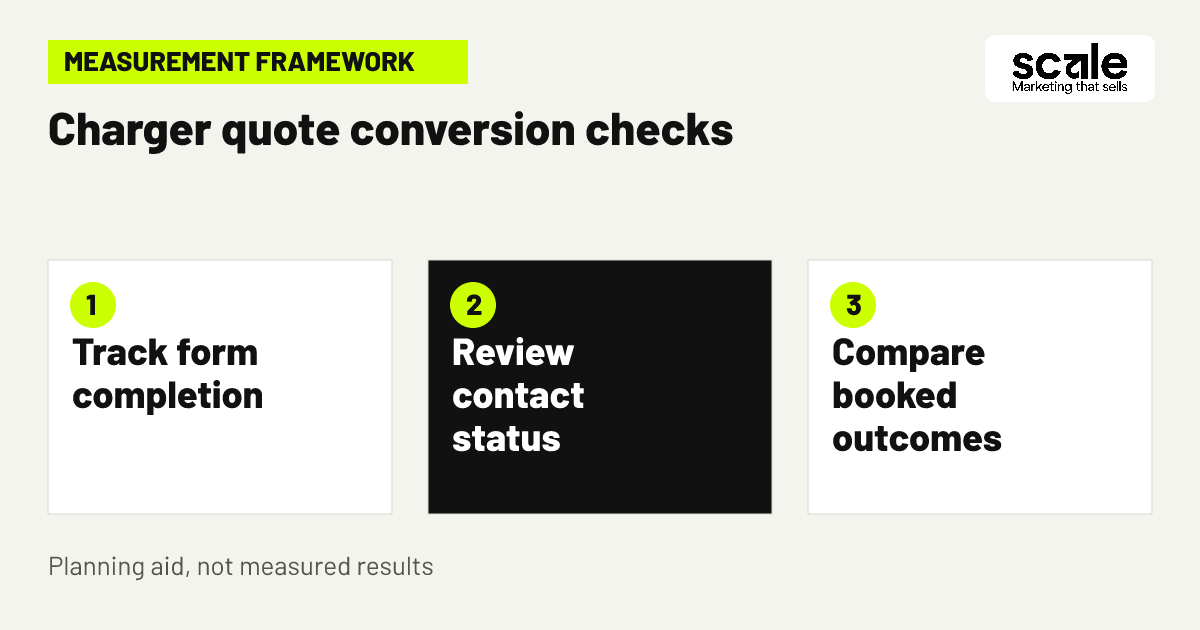
Set up a small measurement plan before launching a revised page. At minimum, distinguish a charger page view, a click on the main contact action, a form start, a successful form submission and a phone-link click. Analytics events can record website interactions such as page loads and link clicks, while custom events can capture an interaction that is meaningful to your own site. Test each event after publication rather than assuming it fired correctly.
Add details that make the data usable without collecting more personal information than necessary. A form submission event can carry a non-sensitive label for service type, such as charger, and page context. Your internal lead record can then connect the enquiry to a contacted, estimated or booked outcome. The website analytics report alone cannot establish whether a job was suitable or completed.
Use tracking as a diagnostic tool, not as a substitute for staff records. A rising number of submits may signal better visibility, weaker qualification or accidental spam. Compare the online path with lead notes and call handling before deciding that a marketing change worked.
Marketing mistakes that make charger enquiries harder to convert
The most common error is sending every visitor to a general contact page. Diagnose it by asking whether a staff member can tell from the submitted enquiry that the person wants a charger installation, where the property is and what should happen next. If not, the page is asking the team to reconstruct intent after the visitor has left.
Another mistake is treating all calls as equivalent. A missed urgent repair call, an out-of-area charger request and a well-qualified planned installation should not be counted as the same conversion. Review call notes and form records together. If the answer rate is weak during advertised hours, correct the schedule or staffing coverage before paying for more promotion.
Finally, do not use a form confirmation as proof that the customer received help. Test the complete handoff: submit a controlled request, verify the confirmation text, confirm the lead reaches the responsible person and check that follow-up status can be recorded. This reveals operational gaps that page copy cannot fix.
Measure the handoff from page visit to booked electrical work
Start with a funnel that follows the real decision: charger page visits, meaningful contact actions, completed enquiries, successfully contacted prospects, estimates issued and booked work. The early steps reveal website friction; the later steps reveal lead fit and follow-up. Keep repair and charger paths separate so an urgent-call pattern does not distort planned-project decisions.
Signals need interpretation. Many page visits with few contact actions can mean the promise, coverage or next step is unclear. Many form starts but few submits often point to excessive fields, technical wording or a mobile usability issue. Healthy submissions but few contacts usually require a response-process review. Many estimates with few bookings may indicate that the expectation set by the page and the estimate discussion are not aligned.
Use Analytics testing tools such as Realtime and DebugView when implementing and checking events, then reconcile online events with your lead records. Google documents that events are used to measure user interactions and can be viewed in these reports. Establish a regular review involving whoever manages enquiries and whoever manages marketing, then choose one practical change rather than reacting to a single datapoint.
A practical review conversation
Ask: Which source brought the enquiry? Was it within coverage? Did staff make contact? Was an estimate appropriate? What stopped the next step? The answers show whether to adjust advertising, page qualification, routing or follow-up.
Prioritize the earliest proven break
Fix the first meaningful point where good prospects consistently drop out. For example, repair a broken form before rewriting ad copy, or clarify coverage before adding more fields. This sequence avoids masking the actual conversion issue.
Conclusion: build one accountable path for charger prospects
The strongest electrician website conversion tips make a charger enquiry easier to understand, easier to send and easier for your team to own. A dedicated page, accurate service boundaries, a purposeful form and clear routing are more valuable than adding generic calls to contact you everywhere. Marketing outcomes vary, so judge changes by whether suitable enquiries move reliably toward a real conversation and estimate.
Take one practical next action: submit a test EV charger request from a phone and follow it through your process. Check the page message, required fields, confirmation, internal routing and recorded status. The first break you find is the most useful conversion improvement to make before expanding promotion.
Related resources
Electrician Marketing · Google Ads Management · SEO Services · AI Implementations