
Can a pilot improve lead-generation decisions?
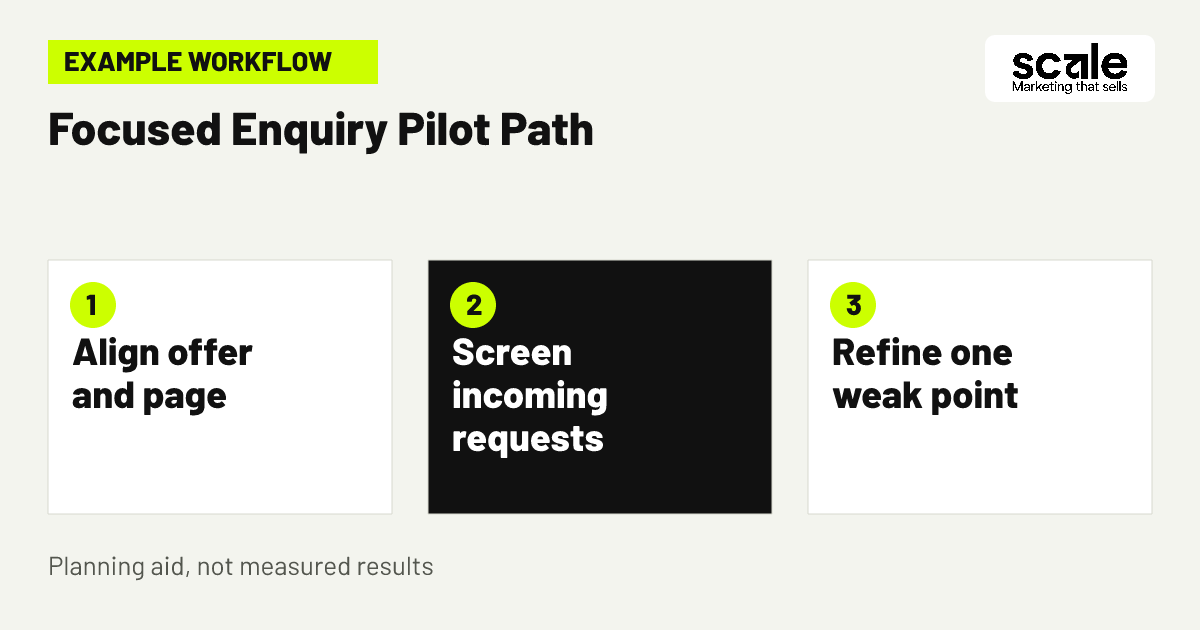
A chatgpt ads pilot campaign should be a focused test of how a business turns interest into suitable enquiries. Rather than trying to promote every service at once, test one customer problem, one offer and one landing-page lead capture path. The result is a clearer view of whether the message attracts the right people and whether the website and follow-up process help them take the next step.
Any possible paid activity needs a verified route, eligibility and terms before activation. That is a pre-launch safeguard, not the campaign strategy. Paid activity is separate from unpaid AI answers, and private conversations should not be treated as targeting or reporting data. The practical work is building a trustworthy customer journey the business can assess.
1. Choose one customer problem worth testing
Pick a problem that prospective customers already recognise and that your business can solve consistently. Frame the lead generation pilot around a single decision, such as whether facilities managers want help assessing cleaning requirements or whether growing firms want an initial bookkeeping conversation. A narrow problem gives visitors a reason to enquire and gives the team a meaningful way to review fit.
This can attract more suitable customers because the message sets expectations before a person reaches the form. A commercial cleaning company, for example, could focus on an assessment for workplaces with regular cleaning needs rather than advertise every available service. Evaluate the choice by reviewing whether submitted requests describe the advertised problem or repeatedly ask for something else.
2. Build an offer with a useful next step
Turn the chosen problem into an offer that is easy to understand and practical to deliver. A suitability call, site assessment, project-scoping conversation or proposal request can work when it explains who it is for, what the customer can expect and what information will be needed. Avoid vague invitations to contact the business when you need to learn about demand for a defined service.
A software consultancy might invite operations teams to discuss integration requirements before proposing a larger project. This gives the visitor a clear reason to submit details while allowing the business to judge whether the need is within scope. Evaluate the offer by checking whether sales conversations begin with the expected issue and whether staff can fulfil the promised next step without improvising.
3. Match the message to a single landing page
Create a dedicated page that repeats the offer in plain English. The headline, supporting copy, form and confirmation message should all describe the same request. Explain the intended customer, relevant service boundaries and what happens after someone submits. This reduces the risk that an appealing promotion produces enquiries for a different service.
For example, a business training provider could promote a planning conversation for managers arranging team workshops. Its page can identify the group types it serves, request the topic and approximate group size, and explain how the provider will respond. Evaluate the path by asking whether visitors who submit the form understood that they were requesting a workplace training discussion rather than general consumer coaching.
4. Remove landing-page friction before driving traffic
Test the landing page lead capture route from a customer's point of view. Check the page on mobile and desktop, required fields, validation messages, confirmation content, notification routing and a real approved submission. Make sure a visitor can tell what the business offers, whether it is relevant to them and what happens after the form is sent.
Ask only for details that help qualify or respond to an enquiry. Location, required service, business type, timeframe and preferred contact method may be useful when they change the next step. Remove curiosity questions that do not help the business serve the request. Keep a clear privacy explanation near the form where appropriate, particularly when collecting contact details.
A home renovation business might ask for project location, property type and the broad work required, but not a long project history at the first contact. Evaluate friction by comparing form starts with completed submissions and by checking for recurring technical errors. Mobile readiness is an important part of testing an online advertising destination.
Questions the page should answer
A focused page should state who the offer is for, what can be requested, what information is needed and what the business will do next. Service-area limits and customer-type boundaries should appear before the form rather than after an unsuitable request has been submitted.
Keep form data purposeful
Do not copy free-text form submissions into broad marketing reporting or use them as advertising targeting material. Report on simple journey stages and review personal details only where needed to handle the enquiry responsibly.
5. Set service boundaries early
State where and for whom the business can provide the advertised service. Clear boundaries save customers time and help the sales team focus on relevant opportunities. Put service areas, customer types or minimum project requirements in the offer copy and near the qualification questions, using language that a visitor can understand.
An IT support provider that works with organisations can say so before the form and ask whether the enquiry relates to an organisation or a personal device. This does not reject a genuine person unfairly; it explains what the campaign is designed to offer. Evaluate this tactic by tracking the reasons for irrelevant requests and looking for repeated misunderstandings that the page can prevent.
6. Give the follow-up team a simple handoff
Marketing conversion continues after the confirmation page. Decide who receives each request, what they need to know, where they record the outcome and how they acknowledge the enquiry. A first response should confirm the request and its next step without making promises that require further assessment. Follow the person's stated contact preference and applicable consent requirements.
A bookkeeping firm can route a request for ongoing business support to a team member who checks location, service need and timing before arranging a conversation. When the receiving team lacks context or responds inconsistently, a useful marketing offer may appear weak for the wrong reason. Evaluate the handoff by reviewing whether relevant enquiries reached an accountable person and received an appropriate response.
7. Define qualified enquiry goals with shared labels
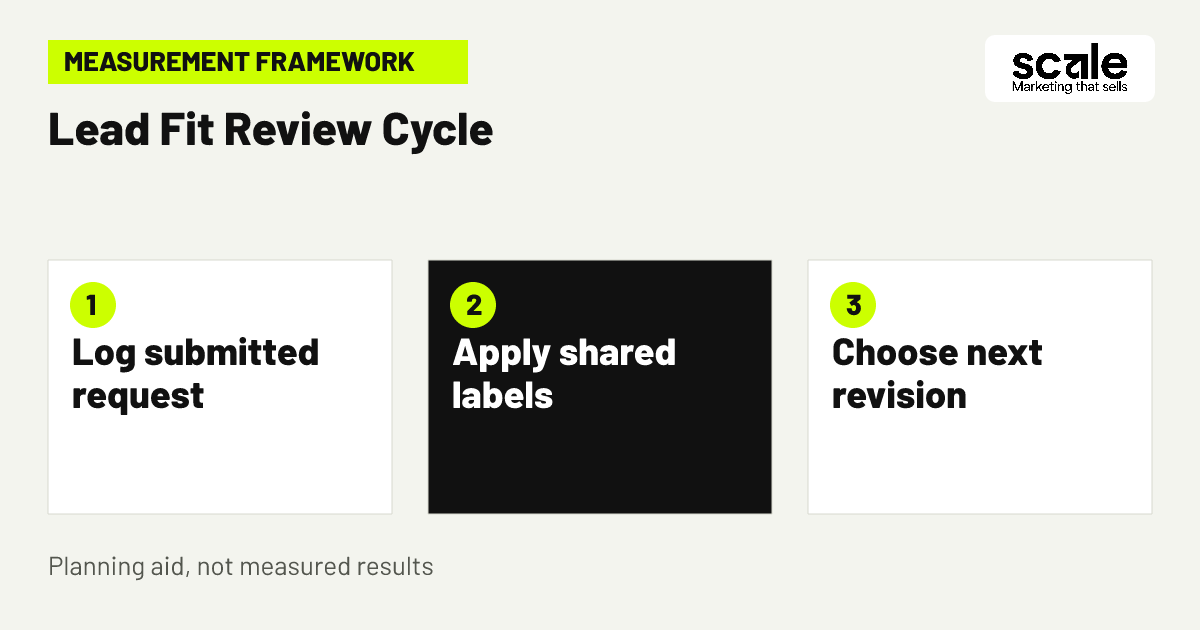
Agree on what a qualified enquiry means before the paid campaign test begins. A practical definition may include someone seeking the advertised service, fitting the intended customer type, being within the service area and providing enough information for a useful next step. The definition should reflect real business capacity, not just the desire for a high form count.
Use consistent labels such as relevant, irrelevant, incomplete, duplicate and unreachable. A commercial cleaning provider could classify a facilities manager requesting a workplace assessment as relevant while marking a household cleaning request as outside the offer. Evaluate consistency by having two team members classify a small sample independently, then clarify any criteria that produce different outcomes.
8. Track journey stages without inflating lead numbers
Create a short event map for the parts of the customer journey your business controls: landing-page arrival, meaningful page interaction where useful, form start, form submission, confirmation view and internally reviewed relevant enquiry. Each stage answers a different question. A form start signals interest or friction, while a submitted form is a contact request, not proof of suitability.
A project management consultancy may find that visitors reach its page and begin a form but leave when asked for details that are not essential to the first discussion. That indicates a form or clarity issue, not necessarily weak demand. Evaluate the journey by maintaining an event dictionary with each trigger, its business meaning, its owner and its limits, while keeping unnecessary personal information out of reports.
9. Use one message angle at a time
A pilot is easier to learn from when it tests one supportable message angle. Choose a clear promise such as help clarifying project scope, checking service suitability or planning a defined type of work. The landing page and follow-up team must be prepared to fulfil that exact message. Avoid combining unrelated services or claims that staff cannot explain in a customer conversation.
A business coaching firm could test an offer for owners who need to clarify growth priorities, rather than mixing leadership coaching, personal coaching, training and consulting into one promotion. Evaluate the angle by reviewing the language people use in their enquiries. If requests consistently describe a different need, improve the wording or choose a better-defined offer before adding more messages.
10. Review enquiry quality with a scorecard
Give the receiving team a brief scorecard that asks the same questions for every request. It can cover the service requested, customer type, location, apparent need and whether enough information exists to choose a next step. The scorecard should evaluate the request against the public offer, not attempt to profile the person.
For a managed IT support offer, the team might check whether an organisation needs ongoing support, falls within the provider's operating area and has described a suitable business need. A consumer device repair request may be valid but irrelevant to that particular campaign. Evaluate the scorecard itself by checking whether its labels lead to clear changes in messaging, forms or service boundaries.
Separate unreachable from irrelevant
An unreachable contact is not automatically an unsuitable contact. Keep this outcome separate so the business can distinguish an offer-fit problem from an incorrect phone number, contact preference issue or follow-up timing problem.
Record recurring patterns only
Use a short note when it identifies a repeated marketing issue, such as confusion about service area or customer type. Avoid creating a detailed profile of individual enquirers when a simple category is enough to guide a page improvement.
11. Change one weak link in the next test
When evidence points to a problem, make the smallest reasonable change that addresses it. Clarify the headline if visitors misunderstand the offer, remove a nonessential field if completion stalls, or bring service boundaries higher on the page if unsuitable enquiries recur. Changing the offer, page, form and follow-up process together makes it difficult to know what improved the journey.
A home services business receiving repeated out-of-area requests could name its served areas before the form and then review later requests for clearer fit. Keep a change log with the date, owner, exact revision, reason and expected signal. Evaluate each revision as a learning step, not proof that a channel will always produce the same outcome.
Marketing mistakes that make pilot evidence unreliable
A common mistake is letting unverified advertising access dominate the plan. Confirm availability, eligibility, account control, terms and reporting before activation, then focus the pilot on the business-controlled offer and conversion journey. Do not describe unconfirmed formats, targeting options or scheduling controls as available features.
Another mistake is measuring every form submission as success. A high submission count can still hide vague messaging, poor service fit or incomplete requests. Use the scorecard to separate submitted requests from relevant enquiries. Also avoid suggesting that paid placements alter unpaid AI answers, or building a plan around private conversation content and undocumented audience controls.
Finally, do not ask for excessive information before a visitor understands the offer. Review each form field and remove any that does not affect qualification or response. This gives people a simpler path to enquire and gives the business clearer evidence about why a conversion may be failing.
How should a business judge whether to continue?
Review the pilot in sequence. First, confirm that approved activity ran through a verified route and that the intended destination received measurable visits or interactions where reporting permits. Next, inspect the page journey: did visitors understand the offer, begin the form and submit without technical barriers? Finally, review business fit: did the team classify enough enquiries as relevant to progress?
Use the pattern to decide what to repair. Form starts without submissions can point to friction, uncertainty or a technical problem. Submitted enquiries that do not fit can point to unclear service scope, customer type or offer language. Relevant enquiries that receive poor follow-up indicate a handoff problem that should be fixed before changing the marketing concept.
Continue only while the offer can be fulfilled, records support a responsible decision and the team can act on the findings. The aim is to identify the weakest link in the conversion path and improve it deliberately, not to force every early signal into a positive result.
Conclusion: build a pilot around customer fit
A chatgpt ads pilot campaign is most useful when it tests a complete route from a defined customer problem to a reviewed enquiry. Start with a verified route for any paid activity, but make the central work the offer, matching landing page, purposeful form, timely follow-up and shared definition of a relevant request.
Take one practical next step: appoint an owner to write a one-page pilot brief. It should name the customer problem, offer, landing-page owner, enquiry recipient, qualification labels, measurement stages and pause conditions. That gives the business a practical basis for improving marketing conversions before expanding activity.
Related resources
ChatGPT Ads Management · ChatGPT Ads Management: Validate Access Before Spend