
What should a conversion plan prove before a test begins?
ChatGPT ad conversion tracking is for businesses evaluating a verified advertising opportunity connected to ChatGPT and needing a responsible way to judge the customer journey that follows. The direct answer is to measure observable actions on your own landing page, record a permitted campaign source where available, and connect submitted enquiries to a consistent internal suitability review. Do not treat private conversations as targeting data or attempt to use them as a reporting input.
This guide is suitable when a business can verify advertising availability and eligibility, owns or can edit the landing page, and has a team able to receive enquiries. It is not suitable as a shortcut for influencing unpaid AI answers, or where no one can define a meaningful business action after a visitor arrives. Paid activity and organic AI answers are separate matters. Start with a limited, auditable journey that your business can actually operate.
1. Decide which customer action deserves to be a conversion
Choose a primary conversion that represents a real commercial handoff, not the easiest action for analytics to record. Depending on the offer, that could be a submitted consultation request, a completed booking request, a purchase confirmation, or a request for a defined assessment. The action should create a task the business can fulfil and review.
Keep supporting actions separate. A landing-page view can confirm arrival, a click on a service section can suggest engagement, and a form start can expose friction. None automatically proves that the person is a suitable customer. This distinction makes conversion measurement useful when a campaign receives attention but does not create worthwhile opportunities.
For example, a commercial cleaning company promoting workplace assessments could count a submitted assessment request as its primary website conversion. It can log form starts as a diagnostic event and later let the follow-up team mark whether the request concerns a workplace in its service area. That gives the business a more honest basis for deciding whether its offer attracts the intended audience.
2. Build a source record that survives the handoff
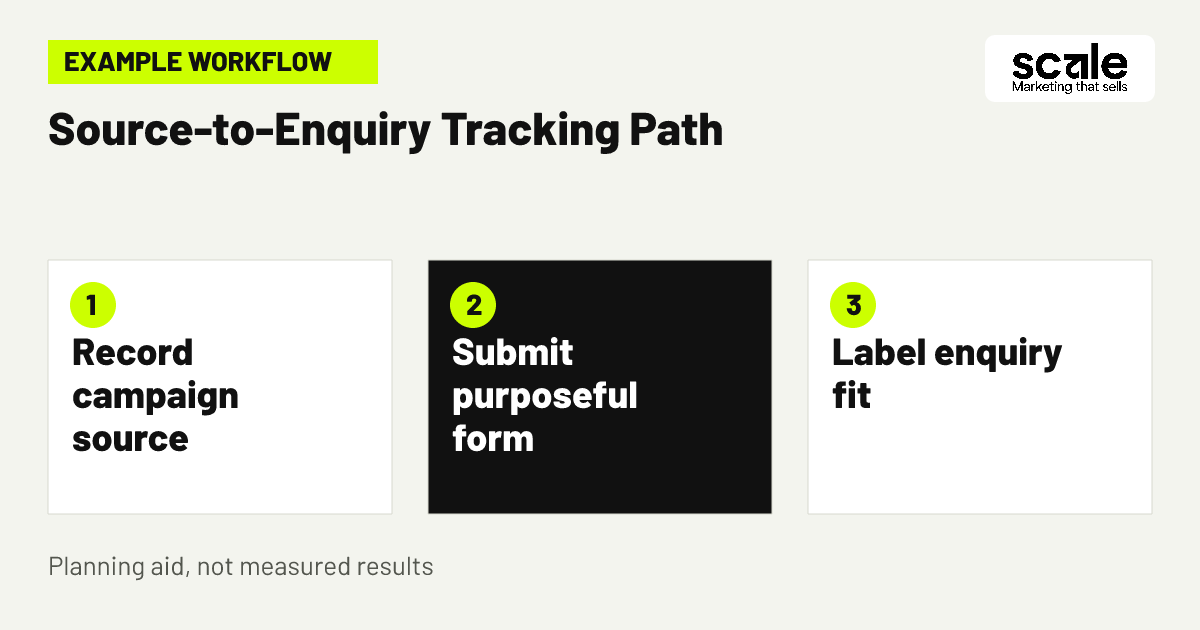
Create lead source tracking before traffic is sent to the page. Where the verified advertising route permits source parameters or a campaign identifier, record that identifier at landing-page arrival and pass it through the form in a controlled way. The aim is to identify the originating marketing activity, not to collect sensitive personal information or reconstruct a private interaction.
Make the handoff simple. A submitted enquiry record can include the campaign source, landing page or offer name, submission time, and internal enquiry ID. Staff should see only the fields needed to respond appropriately. Keep free-text enquiries and contact details out of broad reporting exports unless they are necessary for the customer service process.
Test the full route with a genuine internal submission. Confirm that the source value arrives in the record, notifications reach a named recipient, duplicate entries are handled, and the confirmation page does not fire the same event repeatedly. If the source disappears between the form and the sales record, reporting will over-credit general website activity or leave marketing unable to learn from the test.
3. Test one complete conversion path before promotion
Example: a regional IT support provider has verified that a relevant advertising opportunity may be available and wants to promote an introductory discussion for organisations seeking ongoing support. The business does not build its plan around assumptions about ad formats, audience controls, or private conversation content. It prepares the customer journey it controls.
Its landing page states that the discussion is for organisations seeking managed support, outlines the broad service area, and asks for a business contact method, organisation type, location, and support need. A submitted form creates an internal enquiry record with the campaign source and alerts the person responsible for initial screening. The confirmation message explains what happens next without making unsupported promises.
Before any activation, the team submits a test request on common devices, verifies event recording, checks that the source field reaches the enquiry record, and agrees on lead labels. This scenario does not predict outcomes. It simply ensures the business can distinguish an arrival, a contact request, and a request that fits the advertised service.
4. Match the ad promise, landing page and form question
A conversion path breaks when each stage describes a different offer. Use the same customer problem and next step in the approved promotion, landing-page headline, form introduction, and confirmation message. If the promotion offers a service-suitability conversation, the page should not pivot into a broad catalogue of unrelated services or a vague invitation to contact the business.
Ask form questions only when the answers change the next action. Service type, location, business type, timeframe, and preferred contact method may help route an enquiry. Long background narratives, unnecessary personal details, or questions added merely from curiosity increase friction without improving the response. Put clear boundaries before the form so unsuitable visitors can self-select out.
Review the page on mobile as well as desktop. Check readable copy, field labels, error states, submit controls, confirmation content, and notification routing. General advertising guidance recognises the importance of making websites and ads mobile-friendly; for this conversion path, the practical check is whether a prospective customer can understand and complete the request on the device they use.
If people begin the form but do not submit it, inspect field burden, unclear instructions, validation errors, and whether the required commitment is too high for the offer. Do not immediately conclude that the advertising concept is weak. First establish whether the page is making a reasonable request of a visitor who has only just encountered the business.
A useful landing-page brief
Write the brief as a short set of decisions: intended customer, problem addressed, offer, service boundary, required form fields, destination for notifications, response owner, primary conversion, and internal lead labels. Each decision should have an accountable person.
Questions before publishing
Can a visitor state what they are requesting, tell whether the service is for them, understand what happens next, and submit the form without unnecessary information? If any answer is unclear, improve the page before treating campaign data as evidence.
5. Keep arrival, engagement and enquiry events separate
Use a compact event map rather than an oversized dashboard. The first event is a landing-page arrival tied to the approved source where possible. The next optional event is a meaningful action, such as opening key service details or beginning the form. The primary website event is the completed submission or other defined business request. A later internal label can indicate whether the request was relevant.
This sequence prevents inflated reporting. A visitor who reads the page has not requested help. A visitor who starts a form may be comparing options or encounter an error. A submitted form signals a request for contact, but it still needs a business review. Report each stage by its real meaning so decision-makers can see where interest is being lost or misdirected.
Give every event a written definition, trigger, owner, validation method, and limitation. For example, a form submission should fire only after a successful submission is confirmed, not when the submit button is pressed. This record protects the team from changing labels mid-test and makes technical checks easier when a report looks unusual.
6. Define suitable enquiries with the people who follow up
Enquiry quality reporting should be designed with the team that handles requests, not created solely in an analytics tool. Agree a small shared set of labels such as relevant, out of scope, incomplete, duplicate, unreachable, and follow-up pending. Define each label using the public offer and the business's real capacity.
A relevant request might match the promoted service, intended customer type, service area, and basic timing. An out-of-scope request may be valid for another provider but not appropriate for this campaign. Keep unreachable separate from irrelevant, because a contact preference issue or incorrect detail is not evidence that the marketing message attracted the wrong audience.
Ask reviewers to apply one label promptly and consistently. If two colleagues classify similar enquiries differently, revisit the definitions before using the data to revise an offer. The goal is not to create elaborate profiles of individuals. It is to identify recurring conversion issues that the marketing team can address through clearer wording, better qualification, or a more suitable response process.
7. Use a short sales feedback loop rather than private data
Sales follow-up can improve marketing attribution without accessing private conversations. The receiving team can record the enquiry ID, source, requested service, lead label, and whether a next step was appropriate. These operational facts are enough to compare marketing activity with the quality of enquiries it creates.
Set a review rhythm that is manageable for the business. The marketing owner should look for patterns in labels and journey events, while the follow-up owner checks that records are being completed. If records are late or inconsistent, pause interpretation rather than making a creative decision from incomplete information.
Privacy matters in the design. Avoid adding detailed free-text messages, sensitive circumstances, or speculative reasons for a person's interest to marketing reports. Retain only the information needed to respond to the enquiry and assess the conversion path under the organisation's applicable privacy and consent practices.
8. Check whether the confirmation stage completes the journey
The thank-you page or confirmation message is not an afterthought. It should confirm that the request was received, set a realistic next step, and give the visitor a safe way to correct an obvious mistake. It also provides a controlled point to record a completed website conversion, provided the event triggers only once for each successful action.
Check the form submission process from beginning to end. Test required-field messages, spam controls, confirmation rendering, email or system notifications, and whether a staff member can identify the enquiry in the working queue. A technically recorded conversion is of little value if the contact request does not reach anyone.
If a business offers several legitimate next steps, keep them clear. For instance, a consultancy might separate a general consultation request from an existing-customer support route. Combining them in one generic form makes later review harder because the marketing team cannot tell whether a conversion came from the promoted service or another need.
9. Audit source mismatches before changing marketing
When reported sources and internal records do not align, investigate the data path first. Compare a sample of landing-page arrivals, submitted forms, source values, and enquiry records. Check whether redirects remove parameters, whether the form preserves the approved source field, and whether manual data entry is overwriting the original value.
A mismatch can also come from visitors returning through another route, staff testing the form, duplicate submissions, or an unclear naming convention. Establish a practical rule for how source is assigned and document exceptions. The purpose is not perfect certainty about every visitor; it is a reliable enough record to make responsible decisions.
Use consistent campaign and landing-page names that describe the offer rather than temporary internal shorthand. A future reviewer should be able to tell what was promoted and where it led. If the team cannot interpret its own labels, it cannot evaluate whether message, destination, or follow-up needs revision.
10. Compare enquiry volume with suitability, not just form totals
A form total answers how many contact requests were submitted. It does not answer whether the requests fit the business. Review the journey in layers: arrivals and interactions for delivery context, submissions for expressed contact interest, and shared lead labels for suitability. This creates a more useful view of customer acquisition than a single total.
If submissions are present but a large share are out of scope, inspect the offer wording, customer-type boundary, service area, and qualification questions. If relevant requests are present but staff cannot respond consistently, the weakness is operational follow-up rather than the landing page. If people arrive but do not act, compare the promotion's promise with the page's clarity and request level.
Do not invent certainty where the records cannot support it. Marketing attribution is a decision aid, not a claim that every customer decision has one cause. State whether a source is recorded, whether a website action occurred, and whether an internal reviewer judged the enquiry suitable. These are distinct facts with different limitations.
11. Make one controlled improvement at a time
Use the evidence to identify the weakest link, then make the smallest practical revision. When visitors misunderstand who the offer is for, clarify the headline and service boundary. When form starts do not become submissions, remove a nonessential field or repair an error state. When unsuitable enquiries recur, add a plain-language qualifier that helps people recognise fit earlier.
Record the revision, date, owner, reason, and expected signal in a change log. Avoid changing the ad promise, page structure, form questions, source method, and follow-up process simultaneously. Multiple changes may be necessary over time, but making them all at once prevents the team from learning what addressed the issue.
This disciplined approach is especially important for a new or unverified channel opportunity. Do not assume that a familiar advertising control, targeting option, scheduling method, or report is available. Use only what has been confirmed, and focus optimisation on the business-controlled experience after someone reaches the destination.
12. Set pause conditions before interpreting the results
Write conditions that require a pause or review before activity begins. Examples include unverified advertising access, a material change to eligibility or terms, broken source capture, repeated duplicate conversion events, unmonitored enquiries, unapproved claims, or a landing page that no longer reflects the promotion. A pause condition protects both visitors and the quality of future decisions.
Assign authority clearly. One person should be able to stop the activity for a technical or safety concern, while the budget owner and marketing owner should know how a decision to adjust or continue will be made. Account ownership, billing responsibility, and access recovery should remain under the advertiser's control rather than being dependent on an individual supplier or staff member.
A controlled test may reveal that the offer needs work, the landing page cannot support the enquiry volume, or the records are too incomplete to support a decision. That is useful information. Outcomes vary, and a responsible plan treats uncertainty as something to investigate rather than a reason to overstate early signals.
Marketing mistakes that turn tracking into guesswork
Do not count a click, page view, form start, and submitted enquiry as the same kind of success. Diagnose inflated reporting by opening the event dictionary and asking what each event proves. If a dashboard calls an engagement action a lead, correct the label before anyone makes a budget decision from it.
Do not ask the sales team to supply vague opinions such as good or bad leads. Diagnose weak enquiry quality reporting by checking whether labels have written definitions and whether reviewers use them consistently. A short, shared scorecard is more useful than detailed notes that cannot be compared.
Do not imply that paid activity changes organic AI answers or build reporting around private conversation content. If a source field, targeting rationale, or performance claim relies on information the advertiser cannot lawfully and transparently access, remove it. Keep the plan rooted in verified advertising access and consent-aware first-party website actions.
How should the business read signals and choose a response?
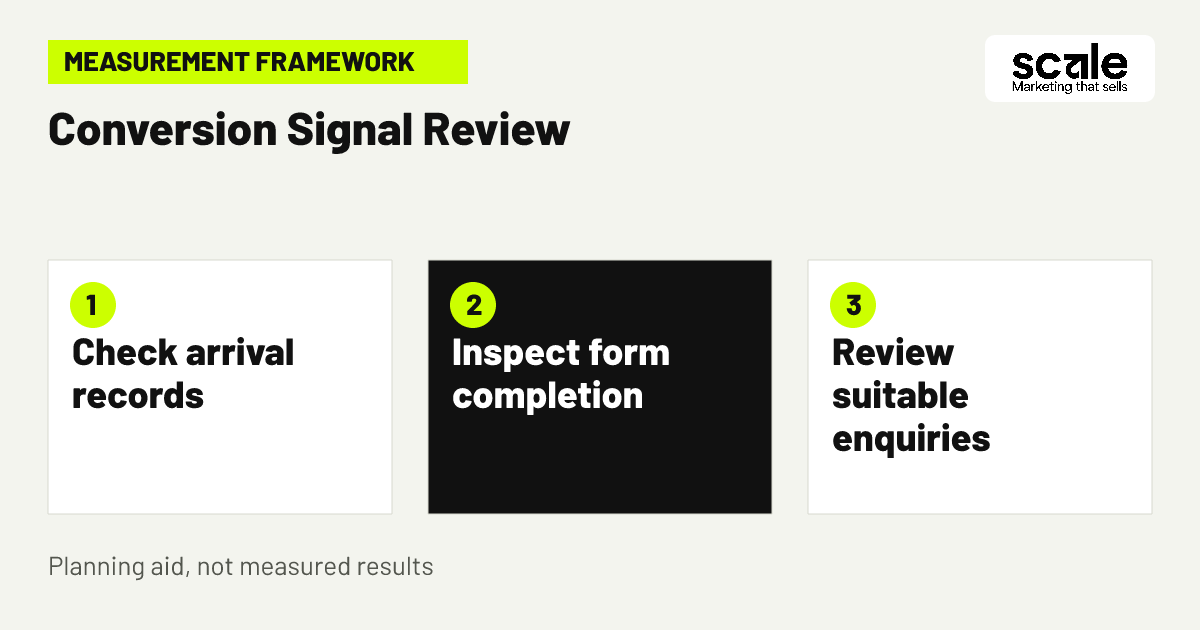
Review the data as a chain, not as a single score. First ask whether approved activity led to identifiable arrivals where reporting permits. Then ask whether visitors progressed through the intended landing-page journey. Finally ask whether submitted enquiries met the agreed suitability definition and received appropriate follow-up. This separates delivery, website experience, and business fit.
A pattern of arrivals without meaningful actions points to a message-to-page mismatch, unclear offer, mobile problem, or unsuitable request. Form starts without submissions point to friction, uncertainty, or a technical fault. Submissions that are mostly out of scope point to qualification and offer clarity. Relevant enquiries with poor handling point to a follow-up ownership problem. Match the next action to the failed link rather than adjusting promotion blindly.
Use a concise reporting view: source or campaign label, landing-page arrival, meaningful journey event where used, submitted request, lead label, and operational note on the next step. This is enough to make conversion measurement actionable without turning customer records into a broad surveillance system.
A practical review question
Ask, “What is the earliest point where the intended customer journey stops behaving as expected?” The answer directs attention to the page, form, source record, or handoff process instead of encouraging broad changes.
When the data is incomplete
Repair tracking and record handling before drawing conclusions about demand or channel fit. Missing source data and inconsistent lead labels are measurement problems first, not proof that the offer should be expanded or abandoned.
Conclusion: turn source records into better conversion decisions
ChatGPT ad conversion tracking should connect a verified advertising opportunity to a business-controlled path: a clear offer, purposeful landing page, recorded source, completed enquiry, and shared review of suitability. It is most useful when the business keeps private conversations out of targeting and reporting, and keeps paid activity separate from expectations about unpaid AI answers.
Take one practical next action: appoint a marketing owner and follow-up owner to write a one-page measurement brief. Name the primary conversion, diagnostic events, source record, form fields, lead labels, response owner, technical checks, and pause conditions. Test that path before any promotion is treated as a meaningful marketing experiment.
Related resources
ChatGPT Ads Management · ChatGPT Ads Management: Validate Access Before Spend · 11 ChatGPT Ads Pilot Campaign Ideas for Lead Generation