
What must be true before paid AI activity is planned?
ChatGPT ads management should begin with verification, not campaign building. This guide is for marketing leaders and teams considering paid opportunities connected to ChatGPT who need a defensible way to decide whether to proceed. The direct answer is simple: confirm that an official advertising opportunity is available to your business, then establish ownership, safety, budget, landing-page, and measurement conditions before committing resources.
Availability may differ by market, account type, advertiser category, product format, and timing. A sound plan therefore uses a gated approach: verify the opportunity from an official source, determine whether the business can participate, define the customer action worth measuring, and only then prepare creative or a test budget. This avoids treating announcements, speculation, or unrelated AI ad products as evidence that a buy is available.
Paid activity must also be kept separate from organic AI visibility. Buying advertising does not establish a route to influence unpaid AI answers, and work intended to improve a brand's public information is not a substitute for a paid-media plan. These are separate decisions with different inputs, controls, and measurement methods.
How can you verify real advertising availability in your market?
Start the ChatGPT advertising availability review by naming the legal advertiser, the country or countries where it operates, its industry, and the people who can accept platform terms. Ask for current official documentation or an authenticated account path that explicitly identifies the ad product, supported markets, access method, policy requirements, reporting, and billing process. A sales message, social post, screenshot, or third-party article may identify a possibility, but it cannot close the availability question.
Record the outcome in a short availability log. The log should state the source checked, the date checked, the advertiser entity reviewed, the relevant geography, the access state, any category limitation, and the next evidence required. If the answer is unclear, classify the opportunity as unverified rather than available. That classification protects the budget and gives the team a clear reason not to invent a launch date.
A business should pause rather than force a plan when access cannot be verified, platform terms cannot be reviewed by the responsible owner, the category faces unresolved restrictions, or the only proposed strategy relies on assumptions about private user conversations. In that position, readiness work can continue, but media activation should remain unapproved.
Separate market access from audience fit
Access answers whether an advertiser can use a particular opportunity. Audience fit answers whether the proposed message, offer, and destination would serve a plausible commercial purpose if access exists. Do not merge these questions. A strong customer proposition cannot create platform access, while confirmed access does not make a weak or unsuitable offer viable.
What the availability record should resolve
The record should resolve who can open or control the account, which markets and advertiser categories are permitted, what approval process governs ads, what billing entity is responsible, and what reporting is available. It should also identify any unanswered question that would change the decision to launch, defer, or decline.
Which readiness decisions belong before a budget request?
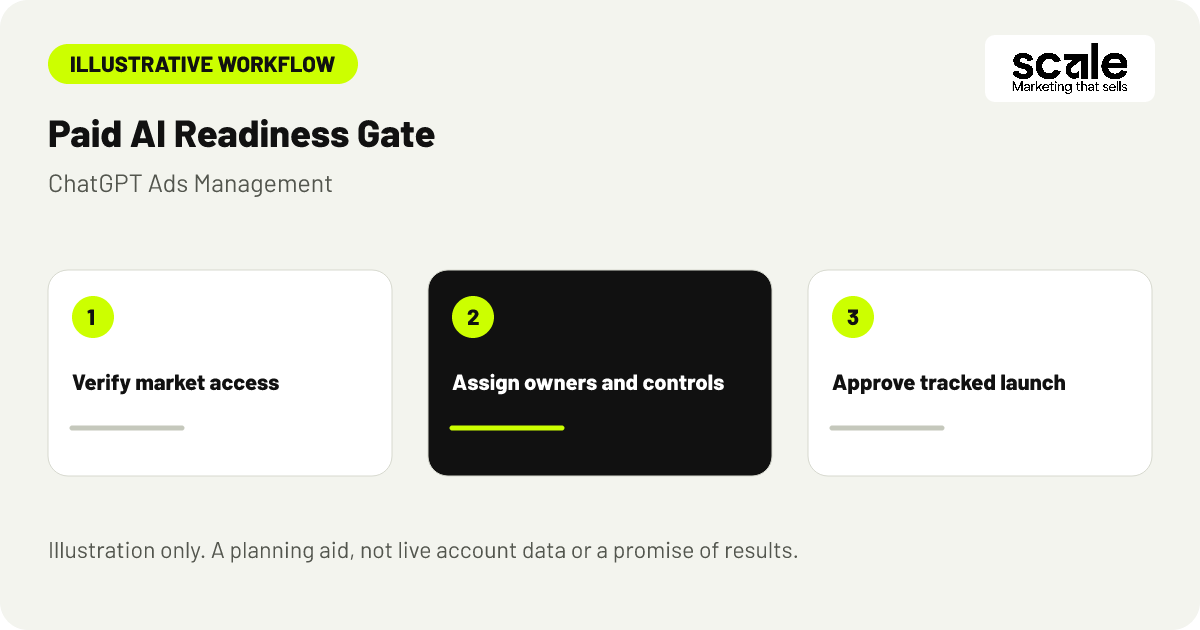
Paid AI platform readiness is primarily an operating question. The business needs a named budget owner, a platform or account owner, an approver for creative and claims, a privacy or legal reviewer where appropriate, and a person accountable for the landing page. Shared credentials and informal approvals make it difficult to audit changes, resolve billing issues, or stop activity promptly if a concern appears.
Run a ChatGPT ad eligibility review before writing ads. Confirm that the legal entity and its offering can be represented accurately, that required disclosures can appear on the destination, and that no proposed message makes a claim the business cannot substantiate. Decide in advance which topics, terms, visual approaches, and landing-page claims are unacceptable. Brand safety is not merely a placement setting; it begins with the promise an ad asks a person to believe.
AI advertising budget planning should begin with a decision threshold rather than a desired volume of exposure. Define the business action that matters, such as a qualified enquiry, completed application, booked consultation, or completed purchase. Establish what evidence would justify continuing, adjusting, or pausing a limited activity. The budget must also cover the operational work around media: creative review, destination changes, analytics checks, and lead-quality follow-up.
This service is less suitable when the business cannot identify a valid conversion action, lacks permission to edit its destination, has no owner for enquiries, or expects a paid placement to solve a credibility, product, or service-delivery problem. Fixing those foundations first usually produces a more useful decision than rushing into a new channel.
Create a one-page launch brief with accountable owners
A practical brief can be written as connected statements rather than a large planning document. State the approved business objective, intended customer need, offer, landing page, acceptable claims, prohibited claims, account owner, billing owner, approvers, conversion event, reporting cadence, and pause conditions. Every statement needs an accountable person, not just a department name.
Questions that expose a weak brief
Ask whether a reviewer could tell why a person should act now, what happens after the form or purchase, who verifies lead quality, and what evidence would cause the team to stop. If these answers are vague, the plan is not ready for spend even if access has been confirmed.
How should a verified opportunity move from review to launch?
Once availability and eligibility are confirmed, implement in controlled phases. First, secure administrator-level account access under the advertiser's ownership and document the agency or team permissions required to operate it. Check that billing responsibility, terms acceptance, and account recovery details sit with the business rather than an individual employee or external supplier. This preserves continuity if personnel or vendors change.
Next, prepare the destination before approving creative. Test that the landing page matches the advertised promise, clearly identifies the business, works on common devices, gives visitors a straightforward next action, and routes enquiries to a monitored destination. Check forms, call links, confirmation messages, and handoff processes. A technically working form is not enough if nobody can respond or establish whether the lead is relevant.
Then align message, audience approach, and governance with the verified product rules. Use only targeting, placement, or format options that are actually documented for the opportunity. Do not infer that a conversational context reveals a person's intent, personal circumstances, or private data. Build ads around a clear offer and publicly supportable value rather than trying to simulate knowledge of an individual conversation.
Finally, complete a pre-launch review using a change log. It should capture the live creative version, destination URL or page identifier, approved conversion definitions, owner contacts, start and stop authority, and any unresolved limitations. The record creates a baseline for diagnosing later changes instead of relying on memory.
What tracking plan respects privacy and still supports decisions?
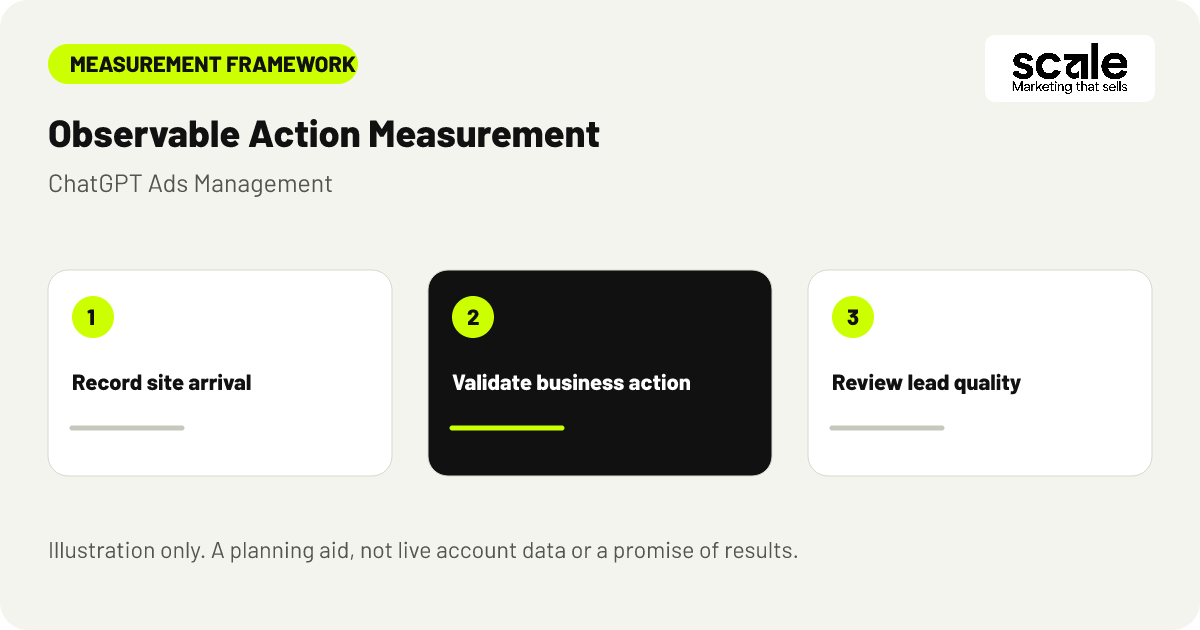
Use a measurement plan based on observable campaign and website activity. Private conversations are not targeting data for this plan, and the team should not attempt to reconstruct, collect, or infer their content. Instead, define the campaign source where the platform permits it, then measure what happens after a person arrives on the advertiser-controlled website or app under the organisation's applicable consent and privacy practices.
Set up a small event map that follows the customer journey: landing-page view, meaningful interaction, form start where useful, submitted enquiry, booking completion, purchase completion, or another defined business action. Only retain parameters that answer a genuine operational question. Avoid placing sensitive free-text submissions, personal details, or speculative conversation labels into marketing analytics.
Validate events before launch. Test each action on the live or approved environment, confirm that it records once at the intended moment, and verify that the reporting owner can distinguish a technical event from a completed business outcome. Analytics platforms can use events to report website or app interactions, and recommended or custom events can be set up when automatic collection does not fit the action being measured. This supports a defined, auditable event plan rather than a collection of disconnected tags.
Choose conversion definitions that a sales team can verify
A form submission may be an appropriate primary signal when it creates a real enquiry, but it should not automatically be treated as a qualified opportunity. Agree how the receiving team will label irrelevant, duplicate, incomplete, and actionable enquiries. Where a later outcome can be joined lawfully and reliably, use it to review lead quality without feeding unnecessary personal data into ad reporting.
Keep a measurement dictionary
For each event, record its name, trigger, business meaning, owner, validation method, and known limitation. A dictionary prevents a click, form start, and submitted lead from being treated as interchangeable evidence during reporting discussions.
Illustrative scenario: a regional adviser tests readiness first
Consider a regional professional-services firm that wants to explore a paid opportunity connected to ChatGPT for consultation requests. Its marketing lead has heard that advertising may be possible, but no authenticated account access or current market confirmation exists. The team does not commission ad copy at this point. It opens an availability log and asks its authorised business contact to confirm whether an official route, applicable terms, and category permissions exist for the firm.
While that question is unresolved, the firm completes preparation it controls. It names the managing director as budget owner, the marketing lead as day-to-day account contact, and a compliance reviewer for service claims. The website owner replaces a broad contact page with a consultation page that explains the service scope, uses an approved enquiry form, and confirms the route for follow-up. The sales coordinator agrees on labels for enquiries that are actionable, out of scope, or incomplete.
The measurement dictionary defines a completed consultation request as the primary website action and keeps a form start as a diagnostic action only. The team tests the form, confirmation state, notification routing, and event recording. It also writes pause conditions: any unapproved claim, broken tracking, unmonitored enquiries, or unresolved platform-policy question stops activation.
If official verification later confirms a suitable opportunity, the firm can review a narrowly scoped launch brief with a known offer, destination, approvals, and measurement logic. If availability remains unverified or the category is not eligible, it has avoided representing a speculative channel as an active media plan. The preparation remains useful because it improves accountability for any future paid activity.
Which mistakes create avoidable risk and misleading reports?
The most common mistake is treating general news about AI products as proof that a particular advertiser can buy ads now. Diagnose this by asking for the current official access path and the specific account or market evidence. If nobody can supply it, the plan is an exploration, not a launch. Label it honestly and do not attach committed spend to an unverified assumption.
Another mistake is promising or implying that paid activity will change unpaid AI answers. Diagnose this in the brief and creative review: look for language that links ad spend with organic answer inclusion, authority, or recommendation. Remove that claim. Paid media and organic information quality can be managed in parallel, but they require separate goals and cannot be used as evidence for one another.
Teams also overvalue convenient signals. A landing-page view, button click, or form start may show interest, but none proves commercial value on its own. Diagnose this by tracing each reported event to a business process and asking who can confirm the outcome. If no owner can validate it, report it as an engagement signal, not as a completed business result.
Finally, do not build a plan around private conversation content, inferred sensitive traits, or opaque claims about conversational targeting. Diagnose this by reviewing every audience rationale and event parameter. If it depends on information the advertiser does not legitimately receive and cannot audit, remove it. Use documented platform options and first-party website actions instead.
How should the team read signals and decide what to do next?
Review measurement at three levels. Delivery evidence asks whether approved activity was able to run and whether the intended destination received attributable visits or interactions where reporting permits. Journey evidence asks whether visitors progressed through the expected on-site steps. Business evidence asks whether the receiving team confirmed meaningful outcomes. Keeping these levels separate prevents delivery data from being presented as proof of commercial quality.
A healthy diagnostic process compares the ad promise, destination message, event flow, and follow-up records. If visits are recorded but meaningful interactions are absent, inspect message-to-page alignment, page clarity, technical load issues, and whether the offer asks for too much commitment. If forms begin but are not submitted, check field burden, error handling, privacy explanation, and mobile usability. If submissions occur but the team marks them as irrelevant, review offer framing, qualification questions, and response process before changing spend.
Use reporting language that states what the data can and cannot establish. For example, an event confirms that a defined website action occurred; it does not reveal a visitor's private conversation or prove why they acted. A lead-quality label confirms an internal review outcome; it may still be affected by follow-up consistency. This discipline gives decision-makers an honest basis for refinement.
The next action should match the failed link in the chain. Repair tracking when events are missing or duplicated. Adjust the destination when the proposition is misunderstood. Refine creative only after confirming that the platform rules permit the change and the landing page can fulfil the message. Pause activity when ownership, policy, safety, or measurement controls no longer hold. Outcomes vary, so continuation should be based on the agreed decision criteria rather than an expectation that a new AI-related channel will behave like another channel.
Conclusion: confirm access, then approve a controlled plan
ChatGPT ads management is appropriate only after the business can verify a real, suitable advertising opportunity and operate it responsibly. The decision is not whether AI is interesting; it is whether access, eligibility, ownership, safety, destination readiness, and consent-aware measurement are sufficiently clear to support paid activity. Keeping paid decisions separate from organic AI expectations makes that review more accurate.
As a practical next action, appoint one accountable owner to create the availability log and one-page launch brief. Do not approve creative production or media spend until that brief records confirmed access, approved claims, account control, a working conversion definition, and clear pause authority.