
What must be true before lead generation can scale?
Google Ads management for lead generation is most useful for businesses that can define a worthwhile enquiry, respond to it reliably and connect advertising activity to a sales outcome. It is for teams that need a controlled way to create demand from active searchers, rather than simply collect the greatest possible number of form submissions. The direct answer is that lead campaigns should begin with measurement and operating decisions, then expand only after the account, landing pages and CRM can distinguish promising enquiries from noise.
This service suits organisations with a clear offer, a reachable decision-maker or buying group, a usable website and a sales process that records what happened after contact. It may not yet be suitable when nobody owns follow-up, every enquiry is treated identically, the offer changes daily, or the site cannot support an accurate enquiry action. In those situations, the first job is to repair the operating system around advertising, not to force more traffic into it.
Scale Digital Agency's Google Ads Management service can cover eligible campaign types including Search, Performance Max, Display, Shopping, YouTube and Local Services Ads. For a lead-led brief, the channel choice should follow intent, conversion path and evidence quality. Search is often the clearest starting point when people use specific service language; other formats should have a stated job and a way to assess whether their enquiries progress.
Which offer and sales boundaries deserve separate campaigns?
A paid search lead generation strategy starts by deciding which differences matter operationally. Create a separate campaign when a service has a distinct search vocabulary, qualification standard, landing page, budget owner or sales destination. The purpose is not a tidier-looking account. It is to make a credible choice later: continue, constrain or change a defined stream of demand without hiding it inside a broad total.
Locations deserve their own boundaries when service areas, availability, messaging, call handling or local teams differ. Likewise, separate sales teams need separate reporting when they own different territories, product lines or lead stages. If the same team sells the same offer through the same page and can act on shared reporting, needless fragmentation can make decision-making harder and leave too little information in each campaign.
Before building anything, agree on the commercial brief in plain language. It should name the service or product, the locations that can truly be served, the enquiry types the sales team wants, exclusions such as job seekers or existing-customer support, expected response ownership, and the event that means an opportunity is genuinely qualified. This prevents advertising from being judged against an unstated or changing standard.
Choose the campaign boundary that supports a decision
Use a service-led structure when the terms, proof points and next step differ by service. Use a location-led structure when coverage or local intent changes the customer experience. Use a sales-team-led structure when routing and CRM ownership must remain separate. A combined structure is sensible only when it still lets the team identify the service, location and owner associated with a lead.
A concise campaign brief
For each campaign, record the intended searcher, the exact offer, approved geography, destination page, primary contact action, campaign owner, CRM queue, qualification definition and exclusions. Add the question the campaign must answer, such as whether a particular service request produces sales-ready conversations. This brief becomes the reference point when new keywords, ads or budget requests are proposed.
How do you verify the account, page and tracking before launch?
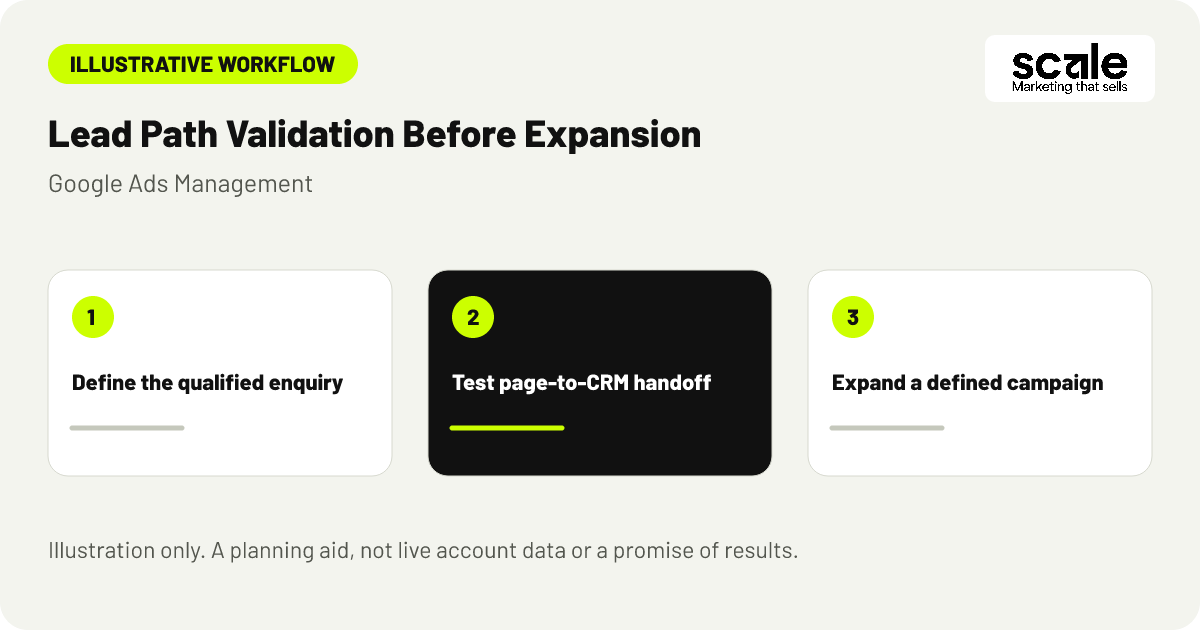
Start with access and ownership. Confirm that the business controls the Google Ads account, website, analytics property, tag setup, call-handling process and CRM fields needed for feedback. Review existing conversion actions and remove ambiguity: a submitted lead form, a booked consultation, a tracked call and a chat request are different actions. If several actions are counted as one success, reporting can make superficial engagement look like demand.
Test every intended path as a real user would. Submit each form, check the thank-you state or event trigger, make a test call where appropriate, inspect required fields on mobile and verify that the CRM record contains enough source information to identify the paid channel and relevant campaign. The destination page should answer the matching query, state who the service is for, provide a credible next step and avoid asking questions that sales does not need to qualify the enquiry.
Build the Google Ads campaign structure around those tested paths. Group targeting by the actual decision boundaries established in the brief, write messages that reflect the service and location where relevant, and direct each group to the most suitable page. Use negative keyword review to protect relevance, but do not assume an exclusion list can compensate for an unclear offer or a page that attracts the wrong audience.
Set up tracking that can be checked, not merely installed
Analytics events can capture specific website interactions, and event parameters can add context to the interaction. Configure only events that correspond to meaningful behaviour, then inspect them during testing rather than relying on a developer handoff. A form-success event should occur after successful submission, not merely when someone clicks a button. A click-to-call event indicates intent to call, whereas a confirmed call outcome needs a separate operational record.
Validation checks before traffic is expanded
Check that the event appears when the intended action occurs, does not appear on a failed or repeated action without cause, and is associated with the correct destination and campaign identifiers where available. Compare the form notification, CRM record and reporting record from the same test. If they disagree, stop and resolve the mismatch before using the event to guide bids or budgets.
What CRM fields reveal Google Ads lead quality?
CRM lead tracking for Google Ads should preserve the information needed to link an enquiry to a later sales judgment without making the sales team complete an impractical form. At minimum, retain the lead creation date, source and medium, campaign identity where captured, service or offer requested, location, assigned owner, contact outcome and current lifecycle stage. Preserve a lead identifier so records can be matched when outcomes are reviewed.
Define stages in language the sales team will use consistently. A workable sequence might distinguish a submitted enquiry, contact attempted, contact made, qualified conversation, opportunity, won business and disqualified lead. The value is in the definitions, not the labels. For example, a qualified conversation could require a service need within the supported area, a plausible timeline and contact details that permit follow-up. Document who can change a stage and when.
Add disqualification reasons that support an action. Useful examples include outside service area, wrong service, duplicate, employment enquiry, insufficient fit, unreachable contact or no current need. Avoid a single vague rejected status. It hides whether the issue lies in search terms, the ad promise, the page, form friction, routing or sales response. Where privacy and internal policy permit, keep fields focused on the operational facts needed to improve acquisition rather than collecting unnecessary personal detail.
Illustrative scenario: separating service requests without fragmenting insight
Consider a hypothetical regional business that offers emergency repair and planned maintenance. The enquiries reach different staff, the urgency and search language differ, and the business wants to understand which requests progress into qualified conversations. A single campaign and a shared generic contact page would make the submitted-form total easy to view but difficult to interpret.
The team creates separate Search campaigns for emergency repair and planned maintenance, each with its own query themes, ad message and destination page. Emergency requests route to the urgent-response queue; maintenance requests route to the team that can discuss scope and scheduling. The form captures service requested and location, while campaign information is passed into the CRM record. A common lifecycle-stage definition lets management compare the quality of the two lead streams without pretending they are the same buying situation.
During review, a high volume of emergency forms marked outside coverage would point first to geographic settings, location language and query intent. A stream of maintenance forms that are contacted but not qualified may point to an overly broad service promise or a page that does not establish the right project expectations. Neither observation automatically means the campaign should be expanded or stopped; it tells the team which part of the path to inspect next.
Why do apparently healthy lead accounts produce poor sales conversations?
A common mistake is optimising only to the easiest action to count. If every button click, form start and form submission is treated as equal, Google Ads lead quality is obscured. Diagnose this by tracing a sample of reported conversions into the CRM. If the reported action cannot be found, the event is firing at the wrong moment or identifiers are missing. If it is found but quickly disqualified, inspect the search terms, ad promise, page copy and qualification questions.
Another mistake is combining unlike services, locations or teams because the account is small. This can conceal a weak route behind a healthy total and makes budget discussions political rather than evidence-led. Diagnose it by asking whether the report can show which offer, area and owner generated each sales-stage outcome. If the answer is no, separate the reporting dimension first, then decide whether campaign separation is also needed.
A third mistake is treating sales feedback as optional. Slow contact, missing stages and inconsistent reasons can make a good enquiry source look weak or an irrelevant source look acceptable. Review a small set of leads from click through disposition with both marketing and sales. Identify the first point where evidence disappears. The remedy may be a routing rule, a clearer status definition, a required reason field or a regular reconciliation process rather than a bid change.
Which signals justify scaling, pausing or changing direction?
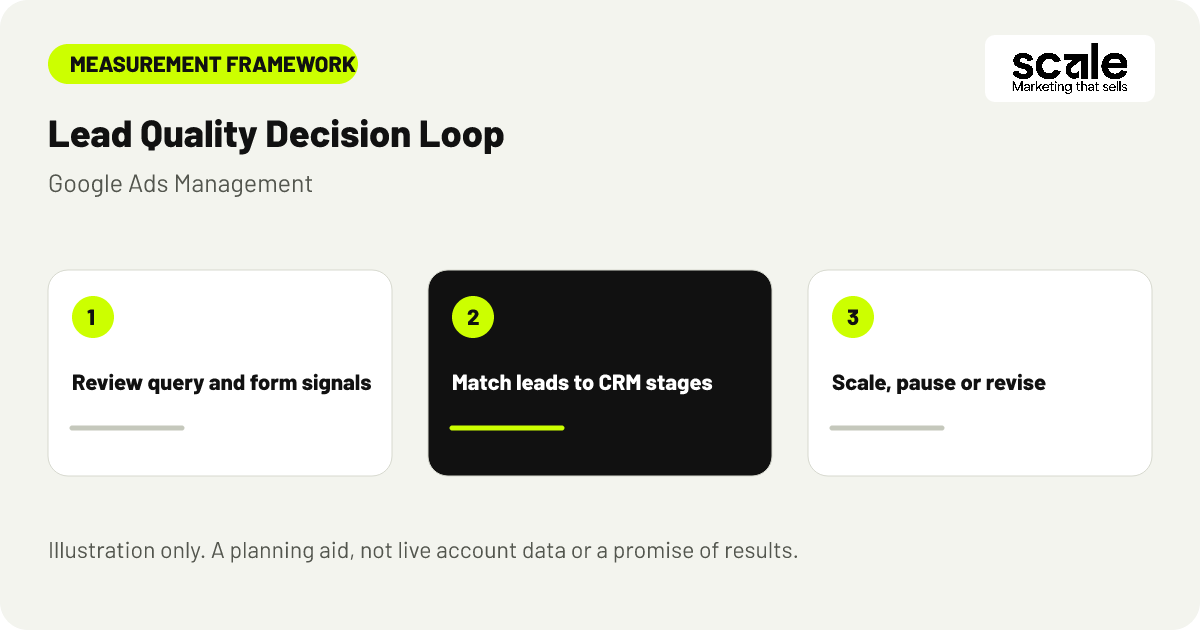
Measure the path in layers. At the advertising layer, review spend, search terms, impressions, clicks and conversion actions to understand exposure and response. At the landing-page layer, review whether the expected form, call or booking action is completed and whether tracking remains reliable. At the CRM layer, review contactability, qualification, opportunities, disqualification reasons and sales outcomes. The CRM layer should carry the greatest weight when evaluating lead generation.
Scale cautiously when tracking remains dependable, the targeted service and geography are producing leads that sales can contact and qualify, and capacity exists to respond without degrading follow-up. A scale decision should specify what expands: a defined campaign, location, service theme or query set. It should also name the guardrail, such as a change in qualification mix or an increase in a particular disqualification reason that triggers review.
Pause or constrain activity when it creates a repeatable pattern of irrelevant queries, unacceptable locations, broken attribution or enquiries the business cannot serve. Change direction when the demand appears relevant but the handoff fails, when a page mismatches search intent, or when CRM outcomes reveal a problem the account structure hides. Do not use a short-term submission total alone to make these decisions; confirm the lead's downstream state before drawing conclusions.
Turn measurement into a regular decision meeting
Bring the account owner and sales owner to the same review with a campaign-by-campaign view of submitted leads and later CRM stages. Start with tracking exceptions, then examine quality by service, location and search theme. End every review with an owner, a hypothesis and a verification date. This creates a learning loop rather than a list of disconnected platform adjustments.
Conclusion: build the feedback loop before requesting more traffic
The right Google Ads management for lead generation decision is not simply whether to advertise. It is whether the business can define a valuable enquiry, route it correctly and use CRM outcomes to improve the next advertising decision. Deliberate campaign boundaries, tested conversion events and consistent sales dispositions make that possible.
As a practical next action, assemble one brief for the highest-priority service: name the audience, geography, destination page, conversion action, CRM owner, qualification rule and disqualification reasons. Test that complete journey from ad click to CRM record before expanding campaign scope or budget.