
What should an agency own to improve repeat engagement?
An email marketing agency for customer retention is a sensible hire when your business has permission-based customer data, an offer customers may revisit, and too little internal capacity to turn those conditions into timely, relevant communication. The right partner should not merely design newsletters. It should help define segments, build and maintain automated lifecycle flows, plan campaigns around real customer needs, protect consent standards, and show what customers do after receiving a message. This guide is for teams comparing agencies or preparing to hand over an existing email programme.
Retention work is appropriate when there is a meaningful customer journey to support after sign-up, enquiry, purchase, use, renewal, or lapse. It is less suitable when the contact list has unclear consent, the underlying product experience is unreliable, order or account data cannot be shared safely, or the business expects email alone to resolve a pricing, service, or inventory problem. An agency can improve the communication system around a customer relationship; it cannot manufacture a reason to return.
Start by framing the decision as operational ownership. Decide which party owns strategy, copy, design, approvals, technical configuration, data definitions, sending cadence, and post-send analysis. A capable agency will be comfortable working inside a documented approval process and will explain the dependencies it needs from your ecommerce, CRM, web, customer service, or product teams.
Which retention capabilities deserve priority in your shortlist?
Use an email marketing agency checklist that tests the full lifecycle, not a portfolio of attractive one-off emails. Ask each candidate how it maps a subscriber from permission capture through onboarding, active use, repeat purchase or renewal, re-engagement, and suppression. Their answer should identify decisions at each stage: what qualifies someone for a segment, what event starts or stops a flow, what message is useful at that moment, and how frequency is controlled.
The agency should be able to distinguish campaigns from automations. Campaigns are scheduled communications with a defined audience and purpose, such as a product education theme, seasonal reminder, or customer update. Automated flows respond to customer states or behavior. Both matter, but automated messages need stronger logic, exclusions, monitoring, and maintenance because they continue running after launch. Ask who reviews flows after they go live and how often stale content, broken links, outdated offers, and conflicting messages are found.
Look for practical segmentation judgement. A weak approach divides the list only by whether someone opened a previous email. A stronger approach considers permission status, relationship stage, product or category interest, recent activity, customer service context where appropriate, and signals that a contact should receive less communication. The agency does not need every data point on day one, but it should explain which fields and events are essential before making sophisticated personalisation promises.
Questions that reveal operational maturity
Ask candidates: Which flows would you assess first, and why? What data must be present for each one? How do you prevent a customer from receiving a campaign that conflicts with an active flow? Who investigates a sudden fall in delivery or click activity? How are copy, design, legal review, and final send approval recorded? Specific answers reveal whether the agency has a repeatable operating method rather than a collection of templates.
A useful answer should name tradeoffs
For example, an agency may recommend beginning with a welcome sequence and post-purchase guidance because those flows establish expectations and collect early engagement signals. It should also say when not to automate: if the trigger data is delayed, if a service issue requires a human response, or if the audience is too broad for a relevant message. The point is not to demand a fixed set of flows; it is to confirm that the agency can match automation to dependable data and customer context.
How should fees, software, ownership, and reporting be compared?
Compare proposals on the scope behind the fee, not the monthly total alone. Separate strategic planning, lifecycle mapping, template production, campaign production, retention flow management, platform administration, data or integration work, testing, and reporting. A lower service fee can conceal limited revision capacity, no proactive optimisation, or a handoff that leaves your team responsible for technical fixes. A broader retainer can be unsuitable if it bundles work you already handle well internally.
Treat software costs independently from agency costs. Confirm who contracts with the marketing platform, who has administrator access, what sending or contact-related charges may change as the database changes, and who approves any additional tools. The business should retain access to its account, audience records, creative files, flow logic, reporting configuration, and export options. If an agency builds assets in its own account, require a written plan for transfer, access continuity, and any work needed to recreate integrations.
Define reporting standards before signing. Agree the reporting cadence, the source systems used, named metrics, audience definitions, attribution assumptions, and the decisions each report will support. Do not accept a report limited to open and click activity without context. The agency should be able to connect email campaign reporting to delivery status, subscriber movement, on-site or product actions where tracking is available, and the health of each important customer journey.
What must be prepared before access and handover?
Prepare a controlled handover pack before granting access. Include the current platform name, account owner, user permissions, sending domains, subscription forms, consent language, privacy contacts, current templates, brand guidance, campaign calendar, existing flow inventory, suppression rules, and a list of systems that create customer data. Add known constraints such as regulated wording, service blackout periods, fulfilment delays, or categories that require approval. This prevents the agency from treating incomplete information as a strategy decision.
Document the minimum viable data map in plain language. For each field or event, state where it originates, what it means, who can change it, how quickly it arrives, and whether it is reliable enough for automation. Examples include sign-up source, customer status, product interest, account creation, purchase, cancellation, support request, or a logged-in action. Avoid providing more personal data than the agreed work requires. Establish the approved method for access, storage, data deletion, and incident escalation with the relevant internal owners.
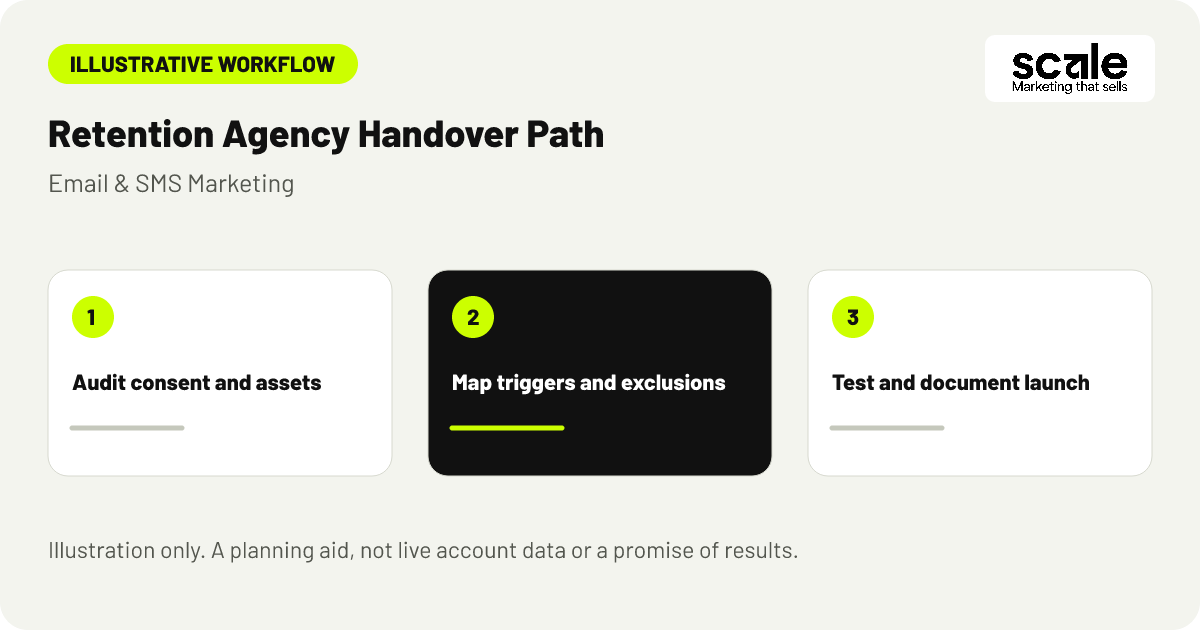
Create an implementation sequence that begins with audit and governance, then moves to lifecycle priorities, technical validation, content production, launch review, and ongoing optimisation. During the audit, check whether forms apply the correct consent status, whether unsubscribe and preference handling works, whether existing flows overlap, and whether links and destination pages match the message. During technical validation, test triggers and exclusions with controlled records before exposing a flow to live audiences. Keep a change log so future teams can understand why a rule exists.
Plan a migration as a controlled change, not a copy task
Marketing platform migration deserves its own scope because a new system changes more than templates. It can affect audience fields, consent records, integrations, sender settings, form behavior, event naming, automated logic, reporting history, and user permissions. Ask the agency to produce an inventory of what will move, what must be rebuilt, what will be retired, and what cannot be directly compared after the change.
Migration readiness checks
Before cutover, verify that consent states remain intact, required fields map correctly, sender identities are authorised, links resolve properly, events arrive in the expected format, and each priority automation handles entry and exit conditions correctly. Run tests using non-customer records where possible. Keep the former platform available long enough to validate exports and historic references, but do not allow both systems to send overlapping communications without explicit controls.
How would an agency turn a vague retention goal into a plan?
Illustrative scenario: a subscription-based business has a sign-up email, irregular promotional campaigns, and no clear view of why contacts become inactive. It is considering an agency because the internal team can approve subject matter but cannot maintain automation logic, audience rules, and reporting. The business first provides consent records, a service calendar, product explanations, cancellation guidance, current templates, and access to the platform through named roles.
The agency begins by mapping the customer states that matter: newly subscribed, newly active, engaged user, approaching a routine customer milestone, support-dependent contact, cancelled customer, and inactive subscriber. It finds that several messages could arrive too close together because campaigns ignore the welcome sequence. Rather than launch many new automations, it recommends a priority set: clarify the welcome journey, set campaign exclusions for contacts currently receiving it, and create a re-engagement decision path that stops when a contact becomes active again or changes preferences.
The working brief states the audience, trigger, exclusion conditions, customer question being answered, destination, owner, approval route, and measurement plan for every message. For the re-engagement path, the business confirms what helpful content it can honestly offer to inactive contacts and what should happen if they do not respond. The agency then tests the trigger, checks message order, confirms preference links, and documents the logic. This is a useful model because it replaces the vague request to increase retention with a set of verifiable communication decisions. Outcomes vary with the offer, data quality, and customer experience.
Which agency selection mistakes create retention problems later?
The first mistake is selecting on visual work alone. Design matters, but retention breakdowns commonly occur in the rules behind the message: an outdated segment, an event that never arrives, a suppression that is missing, or a flow that was not reviewed after a business change. Diagnose this by asking to see a candidate’s approach to documentation, quality assurance, escalation, and routine flow review. If it cannot explain its checks in plain language, polished creative is not enough.
The second mistake is treating contact volume as permission to communicate frequently. A large list may include people at very different stages, contacts with limited consent, inactive addresses, or customers already receiving service messages. Diagnose frequency risk by reviewing every currently active campaign and automation together, then identifying who could receive multiple messages and why. An agency should recommend relevance rules, exclusions, preference management, and a defined method for handling disengagement.
The third mistake is accepting ambiguous ownership. Problems surface when the platform account belongs to an agency, no one owns deliverability or consent decisions, files live in scattered folders, or an integration fails after a website update. Diagnose this with a responsibility table written in sentences: the business owns final commercial and compliance approval; the agency owns agreed configuration and monitoring; the technical team owns source-system changes; each party knows who must be notified when a dependency changes.
The fourth mistake is assuming a migration automatically improves the programme. Moving platforms without cleaning audience definitions, documenting flows, or validating event logic transports confusion into a new environment. If a proposed marketing platform migration starts with importing contacts and selecting templates, pause and request the inventory, field mapping, consent check, trigger test plan, and rollback or contingency process first.
What should reporting measure and what should each signal trigger?
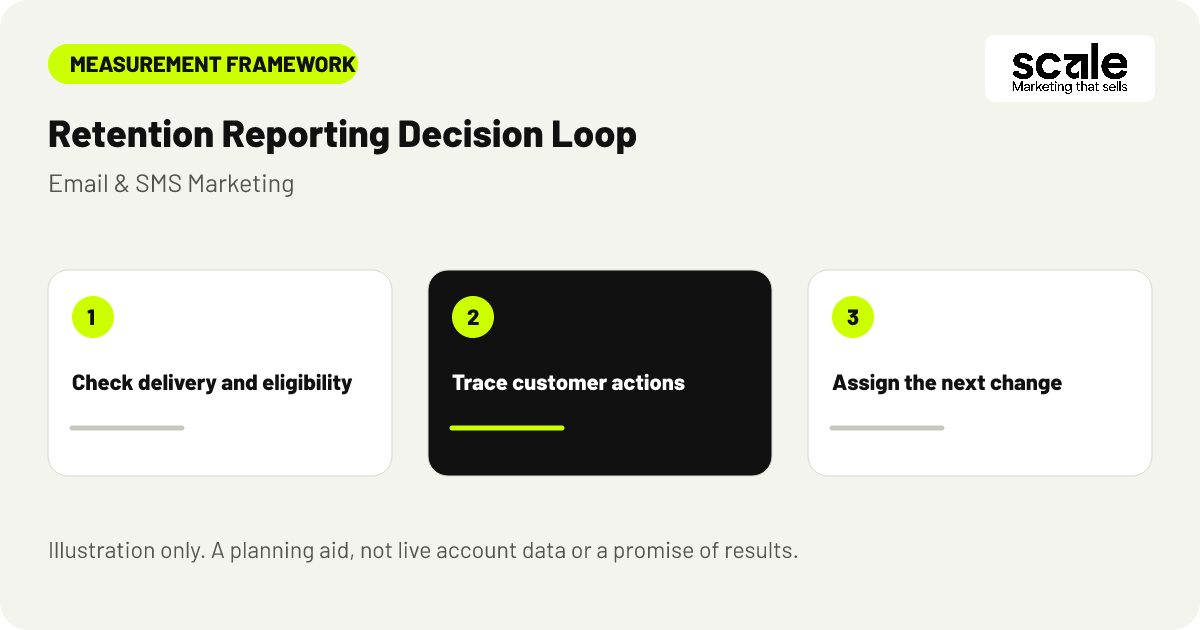
Email campaign reporting should answer whether messages were eligible to send, delivered as intended, understood, acted upon, and connected to a useful customer outcome. Review delivery and bounce patterns to spot list or sender issues; unsubscribe and complaint signals to assess relevance or expectation-setting; clicks and destination behavior to assess message-to-page alignment; and flow entry, progression, exit, and overlap to test automation logic. Interpret metrics by audience and message purpose rather than treating one number as a universal score.
When site or product actions are part of the plan, define the event names and parameters before reporting begins. Events can record interactions such as sign-up, login, click, or purchase, and parameters add context needed for analysis. Validate that the event fires at the right customer action and that authorised team members can inspect it during testing. Event data should support a question, such as whether people who receive a product guidance email reach the intended resource, not create a surplus of dashboards. source-2
Turn signals into practical actions. A delivery issue calls for list, sender, consent, and technical review before more content is produced. Strong clicks paired with weak destination progression point to the landing experience, offer clarity, or tracking definition rather than necessarily the email. A flow with few eligible entries may have an incorrect trigger or a genuinely narrow audience. Repeated campaign-flow overlap requires exclusion logic and a calendar review. In every report, include the observation, likely causes, validation needed, owner, and next change.
Create a shared measurement dictionary
Define each reported metric in terms your commercial and operational teams can use. State the system of record, the audience included, the date range, the event or action that qualifies, and known limitations. For example, distinguish a delivered message from an engaged recipient, a link click from a completed on-site action, and an automation entry from a customer who completed the intended journey.
Review the path, not only the send
A useful review follows the customer path from segment qualification through send eligibility, delivery, interaction, destination, and the next lifecycle state. That sequence helps teams locate the actual constraint. It also keeps an agency accountable for inspecting the operating system around a campaign rather than presenting engagement figures without a proposed decision.
How can you run a confident agency evaluation process?
Give shortlisted agencies the same concise brief. Describe your business model, customer lifecycle, current platform, data sources, permission model, internal team, desired scope, priority journeys, approval constraints, and planned start conditions. Ask each agency to identify missing information, state assumptions, propose a phased scope, and explain how it would measure progress. Comparable answers are more valuable than generic recommendations because they expose differences in thinking and resourcing.
Use an evaluation meeting to probe the work behind the proposal. Ask the agency to walk through one flow from trigger to exit, including data dependencies and exclusions. Ask how it handles a broken event, an urgent campaign request that conflicts with an existing automation, a subscriber preference change, and a request to export assets at the end of the engagement. Clarify meeting rhythm, response expectations, revision limits, and the people who will actually execute the work.
Choose the partner whose method fits your readiness, not necessarily the one promising the largest programme immediately. A business with incomplete data may need an audit, consent cleanup, foundational templates, and a limited flow set before a complex personalisation roadmap. A mature team may instead need specialist oversight, retention flow management, and disciplined experimentation. The appropriate scope is the one your organisation can provide inputs for, approve safely, and sustain after launch.
Conclusion: choose an accountable retention operating partner
The best email marketing agency for customer retention is one that connects relevant customer communication with reliable data, explicit ownership, thoughtful automation, and reporting that leads to decisions. It should be able to say what it will build, what it will maintain, what your team must supply, and what it will check when performance or deliverability changes.
As a practical next action, assemble your handover pack and send the same lifecycle, ownership, migration, and reporting questions to each shortlisted agency. Compare their assumptions and operating detail before comparing fees. The proposal that makes dependencies, tradeoffs, and responsibilities clearest is usually the sounder basis for a retention partnership.