
How insurance agencies can turn searches into quote conversations
Digital marketing strategies for insurance agencies should create useful conversations with suitable prospects, not just website traffic. Local agencies often need to promote several coverage types across different offices, service areas, and languages. A practical marketing mix connects local discovery, intent-led advertising, clear quote-request pages, appropriate follow-up, and feedback on whether enquiries progressed.
Start by deciding which coverage conversations the agency wants to promote, where each office can serve prospects, which languages staff can support, and who owns incoming calls and forms. Marketing can encourage an enquiry, while an agent remains responsible for the policy conversation and suitability process. Review claims, forms, audience settings, and follow-up messages against the agency's insurer, privacy, consent, and regulatory requirements before use.
1. Choose priority coverage, office, and language segments
Avoid promoting every policy to every place with one broad message. Start with segments defined by coverage need, service area, office capacity, and supported language. This gives the agency a clear decision framework for budget, page content, call routing, and campaign structure. It is especially useful when offices have different availability or enquiries are reaching the wrong team.
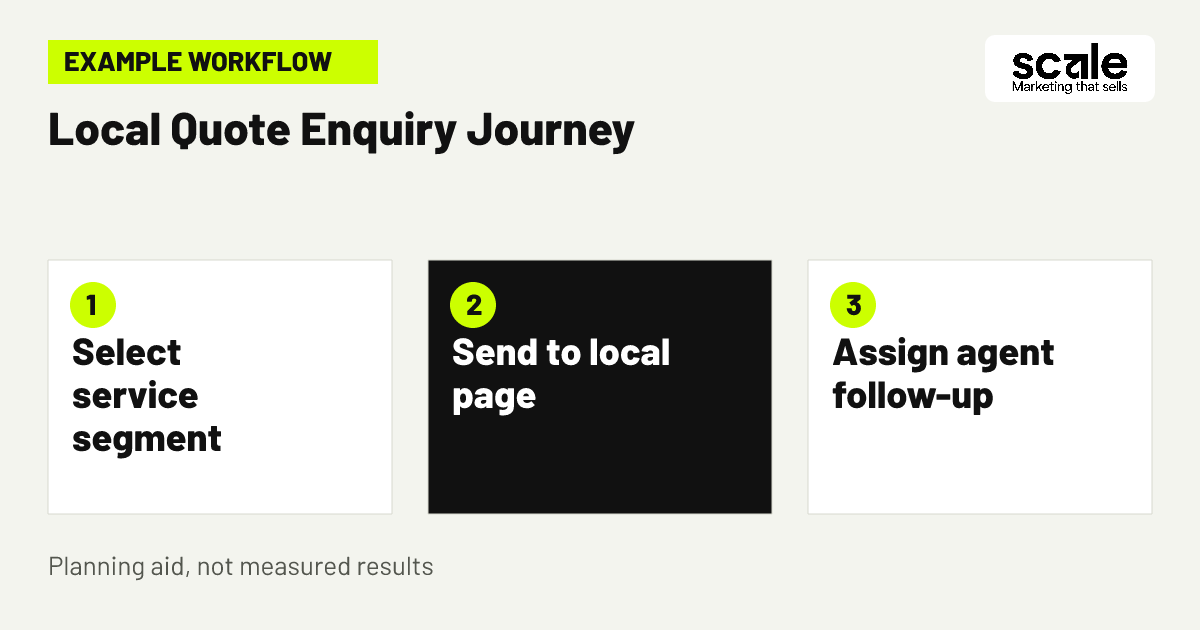
Create a planning grid with the coverage theme, local area, language, response owner, destination page, and outcome to record. For example, an agency could create one path for renters insurance enquiries near a particular office and a separate Spanish-language path only where staff can support that conversation. Compare completed requests, answered calls, quote conversations, and recorded policy outcomes by segment before expanding spend.
Use capacity as a marketing input
Ask each office which enquiries it can answer promptly and which coverage themes it is ready to prioritize. Reducing promotion for an overloaded office can be more useful than sending it a larger volume of enquiries.
Create a segment brief
Document the target coverage, office, approved language, service area, desired action, response owner, approved proof points, and exclusions. This brief gives SEO Services and paid campaign work a clear local focus.
2. Build local discovery around every active office
insurance agencies local seo helps each active office become easier to find when a prospect wants a nearby agency conversation. Give every office accurate public contact information and a dedicated location page that explains its service area, supported languages, relevant coverage themes, and clear route to request a quote or call.
Check the public name, address, phone number, hours, website destination, and office details regularly. A page for one location might describe the nearby communities it serves and offer an approved auto coverage enquiry path, without making broad coverage promises. Evaluate organic landing-page enquiries, calls attributed to the office, profile engagement where available, and quote progression by location.
Give visitors a local next step
Do not send visitors from every office listing to a generic homepage. The location page should make it simple to call the right office or begin a relevant quote conversation on a mobile device.
3. Match paid search campaigns to immediate insurance intent
Paid Search can help reach people who are actively looking for an insurance conversation, provided the agency has an approved destination page and a reliable response path. Build separate campaign themes around the coverage and places the agency can serve, rather than combining all products and locations in one campaign.
For example, a search for business coverage in a named service area should lead to a matching local page with an option to request a quote or contact the appropriate office. Use accurate ad language such as speaking with a local agent or requesting a quote. Google Ads Management can support campaign structure, location settings, and mobile-ready ad destinations. Track calls, completed quote forms, cost per enquiry, and later lead status in agency records.
Exclude clearly irrelevant searches
Review search terms and add carefully chosen negative keywords where they help prevent ads from appearing for unrelated intent. Negative keywords require attention because close variants and matching behavior may not work as a business expects.
4. Create quote landing pages that reduce uncertainty
A focused quote page helps visitors understand what to do next and what to expect after they enquire. It can be more effective than a general services page when it matches the coverage topic, office, or language used in the ad or search result. Prioritize this work when traffic arrives but calls, form completions, or form starts remain weak.
Use a short form for an initial marketing enquiry, explain how an agent will respond, and offer a clear phone alternative. Keep important actions easy to use on a mobile screen. A homeowners page, for instance, can invite a visitor to request a quote conversation and explain that an agent will discuss the details needed to prepare one. Measure form starts, completed forms, call clicks, tracked calls where available, and the share of enquiries receiving contact.
Ask only for an initial conversation
Do not collect sensitive information merely to improve marketing reporting. Capture only what is needed to route the request and begin the approved follow-up process.
5. Publish coverage content that leads to a conversation
Many prospects are still comparing options before they are ready to request a quote. Useful, approved content can help an agency answer early questions and provide a relevant route to an agent. Build pages around common decision moments rather than publishing generic insurance articles with no local purpose.
For example, a business coverage page could list practical questions a local business owner may wish to discuss with an agent, then link to the relevant office's quote path. Keep content educational and avoid presenting it as individualized insurance advice. Review organic visits, quote-path clicks, assisted enquiries, and agent feedback on whether visitors arrive better prepared to talk.
Make each brief conversion-aware
Set the audience, coverage topic, office or service area, approved claims, reviewer, primary action, and related page before writing. This helps content support local discovery and conversion instead of becoming a disconnected resource library.
Use careful policy language
Do not imply that a policy is available, complete, or suitable for every reader. Use content to invite a conversation and leave coverage details to the agency's approved process.
6. Build language-specific journeys instead of translated fragments
If an agency serves customers in more than one language, create a complete journey for each supported language. An ad, landing page, form, confirmation message, and response route should align. This avoids attracting prospects with a language promise the office cannot consistently meet.
For example, a Spanish-language campaign should lead to Spanish-language page text and a confirmed route for Spanish-speaking follow-up, rather than an English-only form. Have someone familiar with the language and the agency's approved wording review the full journey. Evaluate enquiries by language, answered-call patterns, form abandonment, quote progression, and recorded outcomes where appropriate.
Keep language and location aligned
Campaign settings, page copy, and available staff should reflect the markets the agency is actually trying to reach. Recheck this alignment when office availability changes.
7. Ask for local reviews through a neutral process
Reviews can add useful social proof to a local agency's public presence when they come from genuine customer experiences. Build a consistent request process rather than relying on occasional staff reminders. Keep the request neutral, avoid telling customers what to write, and do not offer incentives in exchange for feedback.
For example, after an appropriate customer interaction, an office can send a short request for an honest review and provide a private channel for service concerns. Avoid including policy details in public replies. Review recent feedback themes to identify unclear marketing expectations, location-page gaps, or communication issues that may affect future enquiries.
Protect customer privacy in replies
A public response should not confirm a person's policy, coverage, or relationship details. Keep responses brief and move account-specific discussion to an appropriate private channel.
8. Improve the answer path for calls and form enquiries
Marketing demand is easily wasted when calls are missed, forms have no owner, or prospects are transferred between offices. Define how each enquiry will be assigned by office, language, and coverage category before increasing promotion. This makes lead quality easier to assess because a form completion alone does not show whether a prospect received a response.
Set simple routing rules and give staff a short response guide with the enquiry source, requested coverage theme, location, and permitted next step. For example, a commercial coverage web request can notify the office responsible for that area, while a missed call enters the agency's approved return-call process. Monitor answer rate, missed calls, time to first contact, contacted leads, and quote-created status.
Make ownership visible
Use one shared status process so marketing and office teams can see whether an enquiry is awaiting contact, has been contacted, moved to a quote conversation, or needs a routing correction.
9. Follow up with permission and a defined purpose
A prospect may need time before completing a quote conversation. A clear, permission-based follow-up process can keep an enquiry moving without treating every request as permission for repeated promotional messages. Explain the contact purpose near the form and capture only the consent needed for the channel used.
For example, when someone requests a callback, the agency can confirm their preferred contact method and follow up about that requested conversation where its policies allow. Separate requested quote updates from broader marketing messages, and honor preferences promptly. Track successful contact, opt-outs, completed appointments or quote conversations, and the point where prospects stop responding.
Keep messages relevant to the request
A follow-up should help the prospect take the next expected step, such as arranging a call or providing information requested by the agent. It should not introduce unrelated coverage promotions.
10. Use remarketing only after audience and privacy checks
Remarketing can be considered for people who previously visited a general agency page but did not enquire. In insurance marketing, use it only after the agency has reviewed audience eligibility, consent, platform options, insurer direction, and privacy requirements. Do not assume a particular audience feature is available or appropriate for a campaign.
If approved, keep creative general. A message might invite visitors to return to a local coverage resource or request a conversation, without referring to personal circumstances or implying why someone visited. Review return visits, quote-path completions, frequency concerns, and qualified conversations. Pause the activity if the required audience, consent, or message documentation is unclear.
Avoid sensitive inferences
Do not build messages that reveal or speculate about a person's insurance needs. The marketing objective is to offer a general route back to the agency, not to identify an individual's situation.
11. Connect marketing records to quote and policy outcomes
Advertising and website systems can record a form completion or call action, but the agency's own records are needed to determine whether an enquiry progressed to a quote or policy. Connecting these stages prevents high volumes of poor-fit enquiries from being treated as marketing success.
Use a minimal shared status sequence: enquiry received, contacted, quote conversation, quote issued, policy outcome known, or unavailable. Avoid transferring unnecessary personal or policy information into marketing tools. For example, an office can review aggregate monthly records to see whether local auto campaign enquiries reached the quote stage, then use the pattern to guide future decisions. Compare progression by source, office, coverage theme, and language.
Use aggregate reporting where practical
Marketing decisions often need counts and stage changes rather than detailed customer records. Aggregate reporting can help protect customer information while still revealing where the enquiry path needs improvement.
12. Review budget allocation by local demand and service capacity
An insurance agencies marketing plan should change when office capacity, local demand, or lead quality changes. A fixed budget split can send spend toward an office that cannot respond promptly or a campaign that creates unsuitable enquiries. Schedule a regular review once tracking is consistent enough to compare meaningful outcomes.
Review qualified calls and requests, response handling, quote progression, and missed-call patterns with marketing and office owners. For example, if one location has a high level of missed calls, temporarily direct more promotion to an office that can respond while the routing issue is addressed. Use location settings carefully, because platform location signals are not exact in every situation. Measure budget share, enquiry volume, qualified lead rate, quote progression, and recorded policy outcomes where available.
Change one variable at a time
When possible, document whether the change was to the target area, message, landing page, budget, or routing process. This makes later review more useful than changing several elements without a record.
Marketing mistakes that waste insurance agency demand
A frequent mistake is sending every campaign to a generic homepage and treating every form completion as a successful lead. Compare the visitor's coverage intent, destination page, office assignment, and later lead status instead. Another mistake is promoting a location or language without confirming who will respond, which can lead to transfers and abandoned conversations.
Avoid broad coverage promises, public examples that expose personal details, incentivized reviews, and adding quote requests to broader marketing lists without clear permission. Also avoid judging campaigns mainly on clicks when calls and completed forms are the meaningful enquiry actions. Improve these areas by tightening approved messages, creating relevant destinations, assigning an enquiry owner, and using consistent lead stages.
Do not overlook irrelevant search traffic
When paid search traffic does not match the service offered, inspect search terms and consider carefully selected negative keywords. Exclusions should be reviewed regularly because overly broad exclusions can also reduce relevant reach.
How to measure performance from enquiry to policy outcome
Use a measurement framework that separates demand generation from sales progress. At the marketing level, track completed quote forms, call clicks, tracked calls where available, and important page actions. Test that each recorded action matches the action a visitor actually took before relying on it for budget decisions.
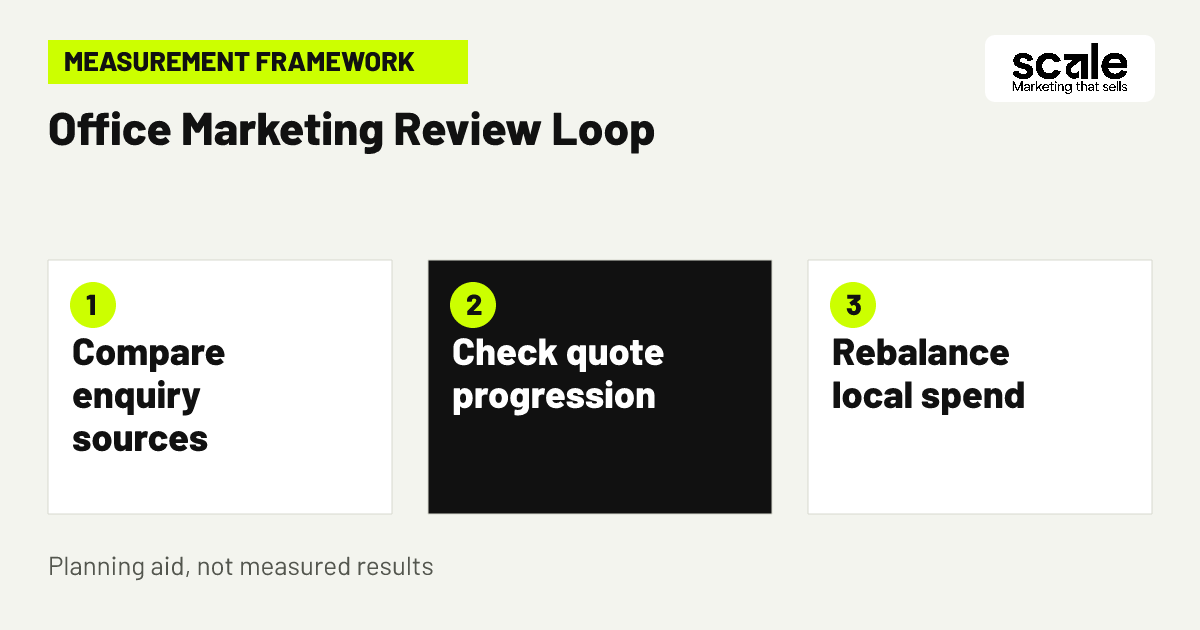
Then combine marketing records with agency-owned outcomes. Review total enquiries, answered and missed calls, completed forms, contact rate, quote conversations, quotes issued, and policy outcomes where records allow. Break these down by office, language, coverage theme, and channel. More leads with weaker quote progression can indicate a targeting, landing-page, or response problem, while strong progression with limited demand may support additional visibility for that segment.
Use a simple review cadence
First check tracking quality. Next review office-level demand, response handling, and quote progression together. This avoids making decisions from isolated click or form figures.
Ask better review questions
Which office answered the most relevant calls? Which page produced completed requests? Where did prospects stop progressing? Which segment most consistently reached the quote stage? What must change before more budget is assigned?
Conclusion: start with segments, local paths, and lead feedback
The best digital marketing strategies for insurance agencies make it easier for the right local prospect to reach an appropriate agency conversation, then show whether that conversation progressed to a quote and, where records permit, a policy outcome. Begin with a small set of coverage, office, and language segments. Then improve each office's discovery path, matching quote page, and call or form handoff.
Hold one cross-office review of active campaigns, profiles, landing pages, and lead handling. List every source of calls and quote requests, identify its assigned office and language route, and define the outcome it should report. SEO Services can support local office discovery, while Paid Search and Google Ads Management can support approved, intent-led campaigns once the agency can track and handle the resulting enquiries.
Related resources
Insurance Agencies Marketing · Google Ads Management · Paid Search · SEO Services